I used to dread the first of the month: the day my rent came due. There had to be enough money in my checking account to send out the payment. But Pedro had been right; my new tenants were an absolute pleasure. Not on the personal level, we never got past a polite hello. But the husband was handy enough that he never came to me with problems, and on the first of every month, the wife slipped the rent check under my door. She got it to me first thing in the morning, often before I was dressed for work, and I had a little dance that I’d do each time in my pajamas. Just like that, rent day went from being one of my most stressful to one of my favorites.
While my first foray into being a landlord was ridiculously easy (truly the house hack with training wheels I’d asked for), I knew I couldn’t count on it staying that way forever. If I was going to own a property and start managing it, I’d eventually need to learn what I was doing, and better I should find out now than to wait for the inevitable crisis to arise. Dylan, for all his shrugging off formal education, always emphasized how much he’d learned in seminars. I found one on managing real estate finances. That sounded perfect.
The seminar cost $100 for the day, which sounded steep to me since all I was going to do was listen to some guy lecture. Of course, I’d blown more money than that on entertainment dozens of times without blinking an eye. And then there was the cost of my Masters. When I broke down how much my education cost, I was probably spending $100 every time I stepped into class. Why did it seem like so much more now? Probably because there was no shiny diploma to show for it, no automatic raise at the end, and I couldn’t roll the cost into some educational loan I could pay off over 20 years.
There were about 300 people in attendance. Many arrived in business suits, but there were also plenty of people in blue jeans, more the Dylan types. I’d brought a notebook and a big thermos of coffee. I was ready to go.
The speaker, John Hopton, jumped right in. “The crazy thing is, most everyone puts a ton of effort into making money and minimal effort into learning how to handle it. Many of you probably fall into that category as well. Or did. By the time you leave here today, every single one of you is going to know exactly what to do with your money.”
“This is what 80% of people do with their money.” He wrote the word Income on a whiteboard. “They make money, and it goes directly into their personal bank account.” He wrote Personal Account and drew a line from income to account. “Now, every time they pay bills, whether it’s their rent, a business expense, or taxes, it comes directly from this account.

“What’s the problem with this approach? Simple. The account never has enough money. Oh sure, you manage to stumble along from paycheck to paycheck. The checks you write rarely bounce. And if you need a little extra cash, no problem, you put that dinner with friends on your credit card, and you buy yourself a month to pay. All this more or less works OK. Until April 15 comes around, and you get slammed with taxes. What happens then?”
Nervous laughter filled the room. Clearly, this was a problem many could relate to.
“There’s not enough cash sitting in the account.” John’s face waxed melodramatic. “You start to freak out, so you let the credit card bill go unpaid this month. Maybe even take a little advance. Suddenly, you find yourself paying 18% interest for months as you work to get your way back to even.
“This is why, for those of you who work regular jobs, your taxes are taken out of your paycheck. Everyone from businesses to the government understands you can’t be trusted with your own money. So employees don’t get stuck in the same way. Not because they’re smarter, but because the entire system is set up to stop them from catastrophically ruining themselves.
“But if you’re in this room, odds are that at least some of your income isn’t coming from a job. And this is where the self-employed screw themselves. They often have no more money know-how than their employed friends, but they don’t have a system designed to be idiot-proof. If that’s you, you need to build that system for yourself.”
One skinny lady in the front of the room called out, “How am I supposed to do that?”
“The first step is to incorporate. I want everyone to repeat after me, ‘I promise that within thirty days of leaving this seminar, I will open a Corporation or Limited Liability Company, if I don’t already have one.’”
Three hundred voices echoed his words.
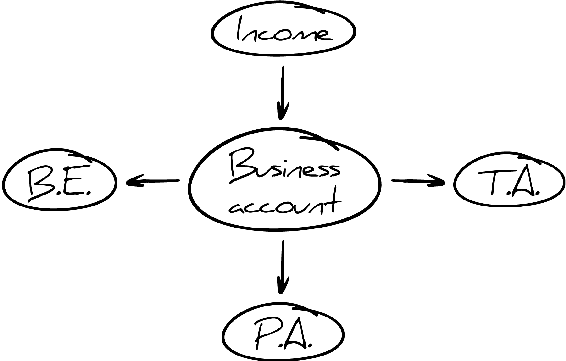
“Good, because if you’ve got income outside of a salaried job, a corporation will save you money. Once you incorporate, open a business bank account and direct all your business income there. As soon as money hits the account, divide it three ways.” John wrote ‘business account’ then drew three arrows from there, one going right, one left, and one down.
“First, put a third into a tax account.” John wrote T.A. after the right-hand arrow. “Most of us falsely believe when we get a check for $10,000 that we have $10,000. Wrong. If we’re lucky, we have $6600, because the federal government’s going to take a third. I say if we’re lucky, because some live in states that pile on additional taxes, leaving them with only $5000. So don’t fool yourself; this money isn’t yours. That doesn’t mean you have to prepay it the way most employees do; that’s just giving an interest-free loan to the government. Stick it into a safe, interest-bearing account, and forget about it until taxes are due.”
John wrote B.E. after the left-hand arrow.
“Another third of your income should cover business expenses. Bill as many expenses to your corporation as you can reasonably get away with. If you drive for work, buy your car from your business account. Why? Business expenses are paid pre-tax, which means you’ll get an extra 30% bang for your buck.
“The third chunk of your income goes into a personal account.” He wrote P.A. below the bottom arrow. “Here’s where you pay for rent, food, clothes, investments, etc. Now when you spend from here, you never have to worry about not having enough money because you’ve already created a solid system to protect your corporation’s and the government’s shares.”
I scribbled notes as fast as I could, noting all those pointers about accounts. His words seemed pretty clear to me, but a guy in the row ahead of mine stood and called out, “I don’t get any of this.” The guy looked to be in his early thirties, with slicked-back hair and a thick Brooklyn accent.
“I’m sorry, sir, am I going too fast?”
“Too fast? No way. Far too slow.”
The lady next to me told Mr. Slick to sit down, but John took it in stride. “I’m sorry, I’m not following. What is your name?”
“Vinny.”
Vinny. Of course, he had to be Italian. I can’t count the number of times I’ve told people I was Italian, and they asked me if my family was in the mafia. I rolled my eyes every time. My father was an attorney, my mother a social worker, and despite my cousin Lorenzo’s offer to lend Dylan money for a ring, there wasn’t a legit loan shark, hitman, or drug runner in my extended family.
Yet Vinny looked like an extra from every mafia movie I’d ever seen. Even his name sounded like it was chosen by a screenwriter for some low budget mob flick. His designer suit was sharp, too sharp for this conference. His hair was combed back, his cologne, which I could smell from my row, was undoubtedly expensive, and it looked like he wore a Rolex.
“So Vinny, what’s your question?”
“I’m trying to figure out why you’re yapping to these fine people about paying taxes.” His hands were so animated, I would have known he was Italian from a mile away. “Why not prepare them to not pay taxes?”
“You’re still young, Vinny, so I don’t blame you for holding onto the dream of getting out of paying taxes. But like they say, there are two things that none of us can avoid, ’Death and Taxes.’”
John’s comment got a polite laugh from the crowd, but not from Vinny. “Yeah? Well, neither one of ‘em has caught up with me yet.”
Grumbling came from around the audience. John still kept his patience; he was a pro on stage. “I get it. When you’re starting out, taxes can sting. And if you’re small and savvy enough, you can keep them pretty low for a while. But I’m telling you, Vinny, this is not a long-term strategy. By the time you’re earning what I am…”
“How much you wanna bet I make more money than you do?” Vinny gave a self-satisfied grin. “And you know what my taxes were last year? Nada.”
At this point, the audience had enough of Vinny. A few people openly yelled at him to shut up.
“If you don’t mind, Vinny, I’m getting the sense people want me to continue with my talk.” Quite a few cheered at this statement.
“Mind? No, I don’t mind at all. If these fools want to learn how to pay more taxes, they deserve what they get. For me, it’s clear I’m not going to learn anything worthwhile here.”
The woman next to me said, “Good riddance.”
Unlike the rest of the crowd, I wasn’t offended by Vinny’s style. Hell, if I couldn’t handle overly slick Italian guys, I’d never make it through a family reunion. Like everyone else, I’d thought what John had to say made sense. I appreciated the idea of opening a corporation and dividing up my income into clear buckets. But I had to admit, I was intrigued by Vinny. What if there was a better way? Was he really able to skip out on taxes entirely? Now that I’d brought my housing costs way down, taxes were my number one expense.
Vinny exited the hall alone, accompanied only by dirty looks. After a moment of picking at my cuticles, I went with my gut, gathered my things, and followed.
By the time I exited the auditorium, Vinny was already leaving the building. I ran ahead and only caught up with him after half a block. “Vinny!” I called.
He turned, then his face grew puzzled as he saw me chasing after him. “Who are you?”
“Amber. Maria Ambrosia Romano.” I had a hunch that if he heard my full name, he’d treat me more like family than like some crazed woman following him down Lincoln Boulevard. “I was sitting behind you in the seminar just now.”
“Ah, good to see there’s at least one other person smart enough to walk out on that guy.”
“I’d…”
“Take a minute to catch your breath.” He gave me a once over.
I regained my composure. “I’d love to hear how you manage to pay so little in taxes.”
Once again, he looked me up and down. “How about I buy you lunch, and the two of us talk it over?”
I’d been hit on by enough Italian guys growing up to know that the only way to handle them was straight on. “I’ve got a boyfriend, Vinny.”
“Oh.”
“But I’d love to sit with you and pick your brain.”
“Well, you know I’ve got a rule I tell everyone wanting my advice.”
“What’s that?”
“If you’re buyin’, I’m talkin’.”
So now he wanted me to take him out to lunch? Other than my dates with Anthony, I hardly ever went out to eat anymore, choosing to cook for myself to save money. Then again, what I was saving on eating out was only a fraction of what I spent each year in taxes.
He saw me hesitate. “I promise you, for the price of a meal, you’ll learn ten times as much as you would from sitting down with some $400 an hour tax attorney.”
How much did I have to lose? “OK, let’s do it. How about this place over here?” I pointed to an Italian restaurant on the corner that had a sign in the window advertising their business lunch special.
“You can take a jar of Ragu off the shelf at the supermarket and make better pasta than these guys. If you want Italian, I’ve got a much better place.”
We were only a few blocks from Little Italy, close enough that I’d walked to the seminar that morning. Vinny led us straight to Giovanni’s, a restaurant I’d loved the two times I’d gone there. Once had been with my parents, the other time with Anthony, as I couldn’t afford to go there on my own. I just hoped whatever Vinny taught me would be worth it.
As we were seated, I had to reassure myself this was worth the investment. “You really pay nothing in taxes?”
“Nada. It’s my private screw you to the government.” His middle finger shot up like a rocket to the moon.
“You hate the government that much?”
A waitress came over with garlic bread and menus. I ordered chicken parmesan, the cheapest entree. But Vinny went all out. He ordered the veal scaloppini, a bottle of white wine, and three appetizers that he said were for the table. This guy’s tax advice had better be good.
Vinny waited until the waitress left, then leaned in and lowered his voice. “My mamma raised me and my two brothers by herself. Nobody worked harder than my mamma, and the woman was as honest as the day was long.” His finger hit the table for emphasis. “But then those bastards from the IRS come knocking on her door and start demanding five years’ worth of receipts from the little store mamma ran out of the basement. She didn’t know you had to keep stuff like that. Mamma lost the house, and we had to move in with my Aunt Cecilia. I can still remember the look of humiliation on her face. I swore then I’d never give the government a dime.”
“You’re not afraid of getting audited?”
He leaned back and smiled so big, his lips practically brushed against his ears. “Not a bit.” The waitress came over and filled Vinny’s cup with wine. She tried to stop when the glass was half full, but he waved her to keep going.
“Look, I know you’re angry, but it’s a stupid game you’re playing. My aunt got audited once. She said it was one of the worst experiences of her life. Sooner or later they’re going to come after you.”
“Sooner or later? Are you kidding? I make a million dollars a year and pay zero in taxes. There’s no sooner or later with a guy like me.” He downed half his glass. “There are few guarantees in life, but here’s one I’ll swear by. Your pal Vinny will get audited every year of his life.”
“But you said—.”
“I said I wasn’t afraid of audits. That’s the difference. I’m sure your aunt skimps a little bit here and there on her taxes like most Americans.” He flicked his hand in disgust. “Worse, she probably chucks her receipts in the garbage like my mother, never thinking she’ll need them again. An audit for her is like a root canal every day for a year. But I know they’re coming. I learned that lesson as a kid. The bastards never find a thing.”
“How do you manage that?” I pulled out my notebook.
“You ever seen the tax code? It’s over five thousand pages long.” Vinny pointed right at me, displaying a fat ruby ring. “You know how much is dedicated to these tax brackets the politicians are always yappin’ about?”
“How much?”
“Less than one percent.”
“So what’s the other 99%?”
“Exemptions, Deductions, Exclusions.”
“Basically, loopholes?”
“That’s what the Democrats call them.”
“What do Republicans call them?”
“Incentives. If the government wants you to do something, they incentivize you with a tax break. They want you to buy an electric car or put solar panels on your roof, Bam!—Tax break. They want you to give to the poor, Bam!—Tax break. Most people look at the tax code like it’s a bunch of penalties, instead of understanding what it is.”
“Which is what?”
Vinny glided one hand along the other. “A roadmap for how to make money and keep it.”
“Is that how the IRS looks at it?”
“Nah. The sadists at the IRS look at it as their own private whips and chains. They go around the country, beating up the innocent and ignorant with it. But they’re not it’s true masters. They can’t be.”
“Why not?” I took a sip of water. With the bill Vinny was heaving on my shoulders, I couldn’t afford a beverage.
“If you had a roadmap for making a fortune, would you spend your life wearing a cheap suit and pushing papers all day long? Not a chance. The masters of the code are all on my side, living large.”
“You make yourself sound like a leech.”
“That’s what the Democrats call me.”
“That doesn’t bother you?”
“Nah. They’re a bunch of hypocrites. Not one of them pays a dime more in taxes than they think they have to, but if someone else is better at playing the tax game than they are, they jump up and down and call them leeches.”
“What do the Republicans call you?”
“Savvy.”
I had to laugh. “So I take it you’re a Republican?”
“Never bothered voting. You could say I’m lacking in respect and admiration for our civil servants on both sides of the aisle.”
“But that doesn’t stop you from using their incentives.”
“Damn straight.” Vinny snapped his fingers. “They make the rules. I play the game.”
The appetizers came. I helped myself to a piece of prosciutto. If I was paying so much for it, I might as well enjoy it. “So let me see if I’ve got this straight. You claim to know this 5000-page tax code better than the IRS, and you use that knowledge to legally make a killing and pay no taxes.”
“You’ve mostly got it. I’m sure the IRS agents acted all high and mighty when browbeating your poor aunt, but they’re still bound by the law. I don’t even bother going to the audits anymore. But my paperwork is airtight. My accountant sites chapter and verse on why each deduction is legit.” Vinny reached for a slice of bruschetta. “The auditors crawl out of there with their tails between their legs.”
“You said I’ve mostly got it. What am I still missing?”
“I don’t know the 5000-page code. What’s the point? There are a million anal details in there I’m never going to need. I only know a handful of the most powerful provisions. I use the same few rules over and over until I owe nothing.”
This is what I came for. The idea of combing through a two-foot thick legal document had less than zero appeal to me. Even if it was a roadmap to fortune, I’d never get through it. But a few, ultra-powerful rules I could handle. I clicked my pen open. “What are they?”
“The Holy Grail of loopholes is depreciation.” Bits of tomato flew out of Vinny’s mouth, but he didn’t seem to care. “You know what that is?”
“That’s the amount something goes down in value, right?”
“You got it. Except it’s a myth.”
“How?”
“Say you buy yourself a car for business. According to the government, it depreciates evenly over five years. Meaning a $20,000 car should be worth $16,000 after one year, and after five years the government says it should be worth nothing. That’s a load of crap. You’d be lucky as hell to get $16,000 for it after the first year, but after five years, it still might be worth $5000 or more.
I thought of the 9-year-old car I’d briefly owned. It hadn’t been expensive, but even with the dented side, it was hardly free. “So you’re saying there’s platonic depreciation, and then there’s actual depreciation.”
Vinny tugged at his collar. “I’m Italian, not Greek. What the hell do you mean by platonic depreciation?”
“There’s an assumption and then there’s the reality, and they’re not the same.”
“Now you’re talking my language. They’re nowhere near the same. But for purposes of taxes, we use whatever number the government gives us, whether it’s accurate or not. Remember, they make the rules…”
“And we play the game.”
“You got it. So back to our car example.” He served himself some arugula salad. “If your business is making $50,000 a year and you depreciate the car at $4000 a year, then you pay taxes on $46,000 for each of those five years.”
“So it’s not that you reduce your taxes by $4000, you reduce your taxable income by $4000?”
“You got it. So maybe you save $1000 or $1500 on taxes.” Vinny picked up a sliver of parmesan and popped it into his mouth. This guy wasn’t classy, but I wasn’t here to date him, so I didn’t care.
“OK, so you get some financial advantage if the government thinks something is tanking in value, but is that enough to make a killing on? Even if the car didn’t go down a full $4000, it probably still went down by the $1000 or $1500 you’re saving out of pocket. So how does that help?”
“Ah, but what if it’s not going down in value? What if it’s going up?” He jabbed a slice of prosciutto with his fork and laid it on his plate. “Let’s say you bought a classic car for $20,000, and after five years, it’s worth $25,000. Then you’d be saving on taxes and making money at the same time.” Vinny grinned as he cut into the ham.
“So is that what you’re into? Classic cars?”
“Please. The classic car market is tiny. There’s a much bigger arena where I make my dough.”
“What’s that?” I asked.
“Real estate.”
“Real estate depreciates?”
“You got it. Over 27.5 years for residential and 39 years for commercial. Don’t you love those numbers? It’s like they drew them out of a hat.”
I grabbed a piece of prosciutto before Vinny finished it off. “Don’t properties usually go up in value?”
“You got it. That’s what makes depreciation the Holy Grail of loopholes. I can be making a killing on a property and still owe zero taxes on it. Better yet, I report it to the IRS as a loss and use it to offset other income.”
“What if the IRS catches you doing this?”
“Catch me? I rub their noses in it. It’s not like I’m making this stuff up.” His voice boomed. “I’m using their freakin’ laws.”
“I’m not getting the numbers here. If I take the cost of an investment and divide by 27.5 years, I can deduct less than 4% a year. It doesn’t seem like that big a deal.”
“It’s 3.63% to be exact, and the math gets worse before it gets better because the land the property is on doesn’t depreciate at all.”
“So how are you saving all this money?”
“You ready to be blown away? You seem to like numbers, so let me walk you through a deal I did a couple of months back. I bought a building with 14 apartments for $1,200,000. You know how much it cost me out of pocket?”
“How much?”
Vinny leaned in and whispered. “Nada.”
“How’d you manage that?”
“OPM, baby!” Vinny downed the last of his wine. “Hey, beautiful,” he called to a passing waitress, “can you fill me up?”
I forced my eyes not to roll. “What’s OPM?”
“Other people’s money.”
“Who’d pay for you to buy a building?”
“$1,000,000 came from the bank at 4.85% interest. Most only get 70-75% on a building like that, but I’m a good customer at my bank. I got seller financing for $150,000 at 8% interest, and for the final $50,000, I took out a private money loan from a guy I know at 10% interest. So it didn’t cost me a bent penny.”
I scribbled the numbers into my notebook. I was missing something, and I wanted to be able to go over the numbers again later. “What does that have to do with depreciation?”
“The land was worth about $200,000, so I acquired $1,000,000 in depreciation for nothing.”
“Wait, you can depreciate what you never spent?”
“You got it. Other than the land, you can depreciate it all, whether the purchase money came out of your pocket or not.”
I took out my phone and pulled up the calculator. I divided $1,000,000 by 27.5 and got $36,364. “You’re telling me you can make over $36,000 a year on this property without owing any taxes on it?”
“A hell of a lot more than that.” Vinny served himself the last of the salad. “The building brings in an income of about $150,000. From that, I can deduct maintenance costs, property management, repairs, even the interest on the loans. After all that, I’m left with around $50,000 a year. Not bad for a building that costs me nothing.”
“I still don’t see how you can avoid paying taxes. If you’re making $50,000 and depreciating $36,000, isn’t there still $14,000 left of taxable income?”
“You’re a smart cookie, you know that? Just how serious are things with this boyfriend?”
“Very,” I said, making sure Vinny didn’t get any ideas.
The main dishes arrived. Vinny breathed in the steam coming off his veal. “I love this place. They’re the only ones who know how to prepare veal like my mamma.”
I took a bite of the chicken parmesan. It was good, but my face hardly bore the signs of elation on Vinny’s.
Vinny took ten bites before he looked up from his veal. “Sorry, what was the last question?”
“How can you avoid paying taxes if you have $50,000 of profits on the books and can only depreciate $36,000?”
“Ah,” his eyes lit up. “When I buy a building, I wind up with a lot more than just walls and ceilings.”
“Like what?”
“Like furniture, lighting, appliances, cabinets. Most people lump all that stuff together with the building costs. But if you separate it, that other stuff mostly depreciates over 5 years, instead of 27.5. That’s called a cost segregation.
“To keep the numbers round, let’s say the land was worth $200,000, the building $800,000, and all that other stuff $200,000. Now what’s my depreciation? Plug that into your phone and see what you get.”
I was already entering it. The $800,000 still depreciated over 27.5 years, so that gave me $29,090 for the building component. For the next bit, I didn’t even need my calculator. $200,000 divided by 5 years is $40,000 a year. Adding those together, I got “$69,090. Wait, but that means you have more depreciation than you’re making.”
“Exactly.” He rubbed his hands together like a movie villain. “So not only does the depreciation knock out the entirety of my $50,000 in profits, it knocks out another $19,000 from other properties.”
This sounded too good to be true. “You can use depreciation from one building to offset income from other sources?”
“You never appreciated the beauty of depreciation before, did you?” Vinny took a bite of his veal, showing an almost indecent amount of pleasure.
“You ever worry about having too much depreciation?”
“Absolutely. The total amount I get is fixed. It’s not like the IRS will send me a check if I have more depreciation than income, so I don’t want to waste it. I keep a close eye on how much depreciation I need. I only do cost segregations when I have enough income to offset. If I didn’t have enough when I bought this last building, I could have let the entire $1,000,000 depreciate over the 27.5 year period. Then, if there came a year when I needed more depreciation, I could retroactively separate out the furniture and stuff.” Vinny popped a scallop into his mouth.
“You don’t need to do the cost segregation when you buy?”
“Nope. And in the year you do the segregation, you get to pile on all that extra depreciation from the years you missed. Using our numbers, the segregation gave us an additional $33,000 a year in depreciation for the first five years. Let’s say I didn’t need that deduction in the first two years, so I waited until year three. In addition to the $33,000 coming to me that year, I can add $66,000 from the two years I missed.”
“You’d be able to offset almost $100,000 worth of income?”
“Ain’t it great?”
“But it’s not like the segregation increases your depreciation, you just use it up faster.”
“The total is the same, but why wait 20 years to get my money?” It was hard not to get distracted by the piece of veal on the end of his fork. “The cash I have in hand now I can use to buy more properties. It’s compounding at a mad rate. Besides, once the higher levels of depreciation are used up, I can always do a 1031 exchange.”
My chicken was getting chewier by the minute. I couldn’t believe how many tricks this guy had up his sleeve. No wonder he didn’t flinch at the price of Veal Scallopini at Giovanni’s. “What’s a 1031 exchange?”
“I sell my current building and use the profits to buy a more expensive one. Just like that, I’ve acquired a truckload of depreciation.”
“You don’t pay taxes on those gains?”
“Nada.”
“So the downside is that you can’t take profits on the first building? You have to reinvest it, right?”
“Downside? I don’t work with downsides.” He cut another piece of veal. “After I make the exchange, I refinance the new building, and take that additional money right back in my greedy little pocket in the form of a loan.”
“And that’s not taxed either?”
“Of course not. In the government’s eyes, it’s borrowed money, not profits.” The waitress arrived with more wine, and Vinny winked at her. “Thanks, Doll.”
“So if you’re making a million dollars of income, you must own a lot of buildings?”
“Almost twenty, but not all this size. I don’t get anywhere near a million dollars in annual depreciation. But depreciation is only one tool in my belt. I like to live large, and I make sure that just about every dollar I spend is a legit-business expense. That means I spend my money pre-tax.”
“How?”
Vinny spread his arms wide. “Take lunch today. We’re talking business, aren’t we?”
“You told me I had to pick up the tab.”
“My mamma raised me to be a gentleman and a sexist. She’d chew my head off if she heard I had a lunch meeting with a nice Italian girl and stuck her with the bill.” He winked at me. “This is on me.”
“Wow. Thank you, Vinny.”
He lowered his voice. “You’re wishing you’d ordered the veal now, aren’t you?”
“Well, you do seem to be enjoying it.” I quickly added, “But the chicken parmesan is very good.”
“Sure, it is.” Vinny hailed the waitress. “I want you to pack up this lady’s chicken parmesan to go and bring out another plate of veal scaloppini.”
The waitress reached out for my plate, but I stopped her. “You can take what’s left of the chicken when you come back with the veal.” I took another bite. Now that I was no longer paying for it, it tasted a hell of a lot better. “How is this a business expense for you? You’re giving me all this free advice. It should be an expense for me.”
“Real estate is all about networking. So when two investors go and spend the entire meal talking shop, it’s a business expense. You might think you’re getting all the benefit, but who knows? Three years from now, you might come across a hot property that’s out of your price range. You’ll walk away, but later that day, you’ll pass a bistro and see a guy sitting outside eating veal scaloppini. Suddenly, you’ll think, ‘this property is perfect for Vinny.’ You give me a call, I close the deal, and I make a million dollars.”
“You’re full of crap, but I appreciate it anyway.”
“Don’t laugh it off; that’s how this business works. I find most of my properties through referrals.”
“Well, in that case, I thank you for the meal, and I thank your mamma for raising a gentleman.”
“My mamma’s the best.” He brought his fingers to his lips and kissed them, Italian style.
“With all this money you’re making, I assume she can lay easy these days.”
“Actually, she’s overseeing the renovation of a building I bought in Hawaii.”
My fork dropped onto my plate, making a loud clang. “You put her to work?”
“I put her on the beach. Trust me, my mamma knows she doesn’t have to lift a finger on that property if she doesn’t want to. But she learned her lesson with the IRS, and she knows the power of deductions.”
“And she doesn’t have to do any work?”
“Get this, the IRS says that only half of each day needs to be spent on business for the entire thing to be considered a full business day. You know what they consider a business day? Eight hours. The lazy bums. So she spends four hours and a minute each day on the property, overseeing the construction, or out shopping for furnishings, then she clocks out and spends the other twenty hours doing whatever she wants.” He counted the items on his fingers, relishing the jab he was making at the IRS with each one. “Her first-class ticket, her penthouse suite, her convertible rental car, all her meals, they’re all legit deductions.”
“All of it?”
“Mostly. Her meals are only 50% deductible, but she’d have to eat anyway. The rest, I can deduct every red cent.”
My veal arrived, and it took only one bite to see why Vinny was so obsessed. If I ever came across a hot property out of my price range, there was no question I’d refer it to Vinny. Just for the veal alone.
My mouth was too busy to ask any more questions for a while. But when I was halfway through my veal, I said, “I’m still trying to get my head around this. You’re saying I don’t have to pay taxes? It makes no sense. Say I have a job paying $80,000 and I—.”
Vinny threw up his hands. “Whoa, stop right there. If you’re planning on being a salaried shnook, the government’s got you by the balls.”
I wasn’t so worried about the government. If they could find my balls, they could have them. I was far more worried about Vinny. My eyes shot over to the second wine bottle, now empty. I’d had half a glass, so he’d drunk the rest. The dessert menus arrived. I wouldn’t ordinarily impose on Vinny’s generosity but ordered the chocolate soufflé, which takes a notoriously long time to make to give him time to sober up.
“Fine, so let’s say I’m not a salaried employee. Let’s say I’m making $80,000 working for myself.”
Vinny crossed his arms in a giant X. “Wrong. Now you’re doubly screwed. You’ll be paying 15% self-employment tax on top of your income tax.”
“What’s self-employment tax?”
“Social Security and Medicaid.”
“Don’t I already pay that?”
“If you’re working a job, you pay half, and your employer pays half. Once you’re self-employed, it’s all on you. By the time you add it up, you might pay more in Social Security tax than you do in income tax.”
“That can’t be.”
“No? Not only does the government take 15%, but they still make you pay income tax on that 15%. They’re taxing your taxes. Then, if Social Security is still around by the time you’re old enough to receive it, they’ll tax you on your distributions too. All so they can supposedly invest it for you at some lame rate of return. And the more you put in, the lower percentage of it they pay you back.”
“Why would they pay you back a lower percent?”
“Because it’s not an investment, it’s a safety net. The more you earn, the less Uncle Sam figures you need it, so your contribution gets redistributed to those who earned less. You’re better off paying none of it. You’ll make ten times as much investing it yourself if you know what you’re doing, and you won’t have to wait forty years to enjoy it.”
I chewed over my veal and his words at the same time. “You talk about all this stuff as if it’s optional.”
“It is. If I don’t have to pay it, neither do you.”
“But you never showed me how. Back to my example. If I’m making a salary of $80,000, how do I avoid paying income and Social Security tax on that?”
“Say I cut off my finger in some construction accident.” Vinny held out the finger with the giant ruby ring. “I’m rushed into surgery, and the doctor sews it back on. A few months later, I come back and complain, ‘It still doesn’t work the way it used to. Can’t you do any better?’ The Doc replies, ‘Absolutely. Next time come to me first, and I’ll show you how to not cut it off.’”
“I don’t get it.”
“Once you’ve earned your money on a salary, you’re already screwed. There’s only so much the world’s greatest tax guy can do for you. You’d be better off seeing a priest.” Vinny devoutly clasped his hands before his chest. “So don’t come to me after you’ve earned the money and say, ‘Vinny, how do I protect my money from the big, bad IRS?’ You have to come to me first, before you’ve ever made the money. Then I can teach you how to earn it in a way they can’t touch.”
“Which is how?”
“Passive income. Self-Employment tax only applies to active income. Also, all those things I told you about depreciation offsetting your other income, most of that also applies only to passive income. To escape the grips of the IRS, you need to take your active income and use it to build up passive income sources.”
This was starting to sound like Dylan-talk. “What do you consider passive?”
“If you have a business, for your work to be considered active, it has to be regular, continuous, and substantial.”
I wrote down his words, but despite being plain English, they sounded like jargon. “Regular, continuous, and substantial?”
“I know. You can just picture those jerks fondling their thesaurus, can’t you? There are like seven different tests to determine if your business qualifies. But if you work in it less than 500 hours a year, and all the work isn’t falling on you, it’s likely considered passive.”
“You work less than 500 hours a year in your real estate ventures?”
“Real estate is a special category. The type I do, buying homes and renting them out, is almost considered passive by definition.”
“But what if my business isn’t in real estate and it requires me to work more than 500 a year? Am I stuck paying 15% self-employment tax? I know you couldn’t stand the speaker today, but he was pretty insistent that we should all open corporations. Wasn’t that to protect us from taxes?”
“If it’s not passive income, I can’t get you out of all the taxes on it. But I’ll give John that much, having a corporation can help. Back to your example of making $80,000 a year. If you report that you’re self-employed, the government will want self-employment tax on all of it. But let’s say you form a corporation. Then on your taxes, maybe you’ll claim that you took a $40,000 salary, and you made another $40,000 in profits.”
“How does that make a difference?”
“You only pay self-employment tax on wages.”
“Which is why passive income doesn’t pay it.”
“You got it.”
“So why not call it all profit?”
“If you pay yourself too little, the IRS will be all over you like hemorrhoids on my Uncle Freddie’s ass. They’ll reclassify all the distributions as wages, so you’ll pay self-employment tax on all of it. Then those leeches will slap you with penalties.”
“So how can I know what’s a good amount?”
“What would you reasonably pay someone else to do your job? If the job market demands you pay $50,000, then you better declare $50,000 as wages, or else you’re begging for trouble.”
“Because if I don’t, they’ll get the entire $80,000?”
Vinny nodded as he worked at his teeth with a toothpick. “They might. You try to get away with too much, you give the bastards power. Learn the rules, follow the rules, and they’ve got nothing on you.”
“Even as you pay next to nothing in taxes?”
“In my case, nothing at all.”
The desserts came. After one bite of soufflé, I felt well rewarded for looking after Vinny. Then my mind started reeling with everything I’d learned, and I grew annoyed. “You don’t feel bad at all about not contributing your fair share?”
“I contribute more than my fair share. Just not through the bloodsucking government. You have any idea how many families in my old neighborhood only have food in their fridge because of the help they get from good old Vinny? My money does a hell of a lot more good there than funding an overpriced drive shaft on an aircraft carrier.” His speech was coming steadier and his vocabulary less vulgar, so I assumed he was sobering up.
When the check came, Vinny took a picture of it with his phone.
“What are you doing?” I asked.
“You think a year from now when my accountant is going through my expenses that I’m going to remember what this bill from Giovanni’s was for? The trick to beating the IRS at their own game is to document everything, the sooner, the better.”
He typed on his phone, then spun it around for me to see. Beneath a shot of the receipt and the price was a caption: Lunch during John Hopton’s real estate finance seminar. Networking meal with fellow investor Amber Romano. “You think the IRS will ever get into a pissing contest with me over this expense? Not a chance, it’s too well documented, too easy to justify. They only bully people like my mamma, who wasn’t anal enough to keep track of each expense.”
“But she does now?”
“Damned right. My family might not be the world’s fastest learners, but once we get a lesson, we never forget it.”
“You don’t ever think it’ll make economic sense for you to pay some taxes?”
“Economic sense? Perhaps. But I’d rather spend two dollars avoiding taxes than give one dollar to the government.”
“That’s insane.”
“Is it? My vendetta has led me to uncover dozens of loopholes. It’s saved me a fortune.”
I sat back, my soufflé gone, my head feeling like it was about to explode. I truthfully hadn’t followed everything Vinny had said at lunch, and I was probably going to have to study my notes like a school kid. But I got enough to realize how narrow my perspective on taxes had been up until now. “All this is going too fast for me.”
“Catch up!” He stood up. “Don’t ever expect the world to slow down to your speed.”
