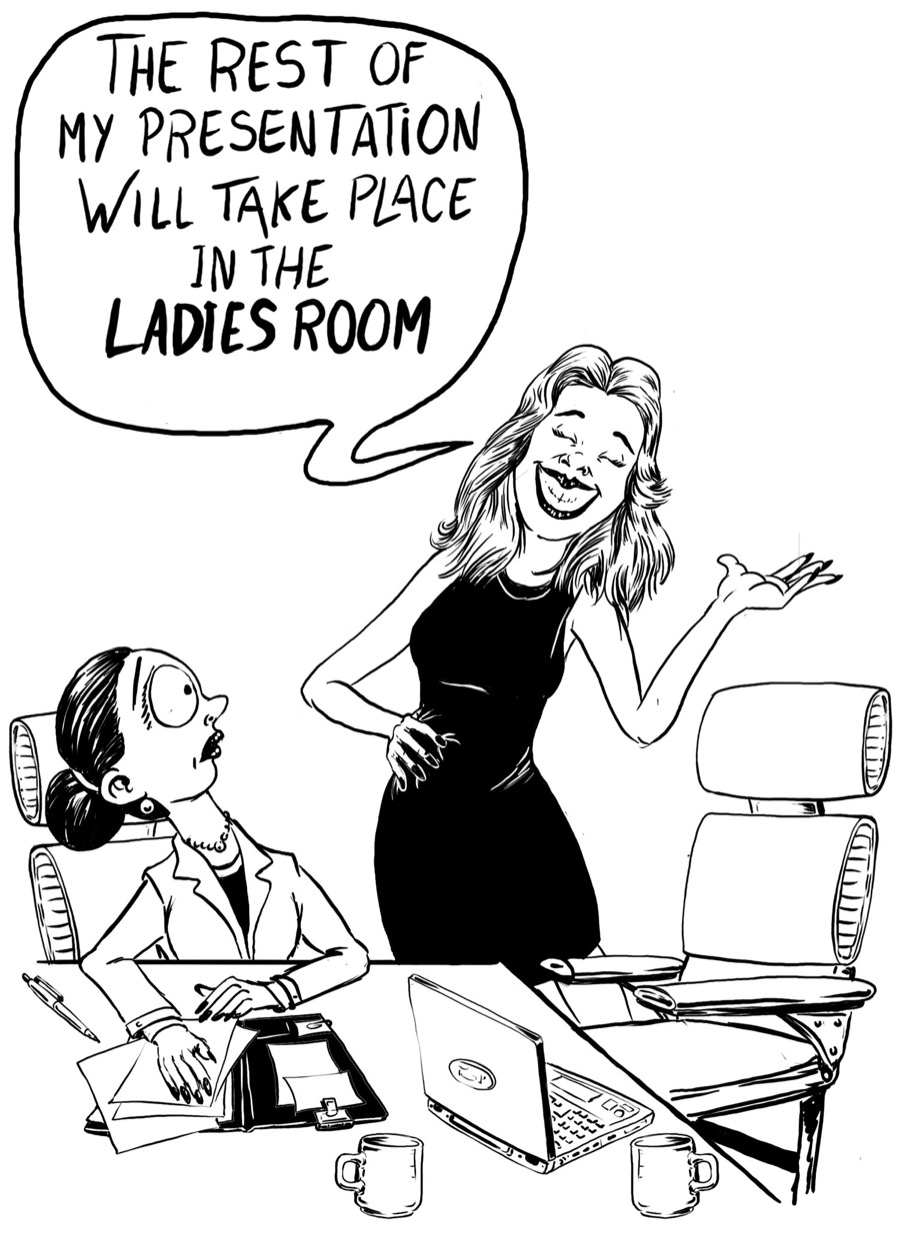
Sara Blakely sat across from Diane, a Neiman Marcus hosiery buyer, watching the opportunity of a lifetime slip away. The year was 2000, and the buyer only grudgingly gave Sara ten minutes of her time because Sara had flown in for the meeting. But Diane was unimpressed by the 29-year-old, self-proclaimed inventor who’d shown up to Neiman Marcus headquarters with her battered, lucky red backpack, a color photocopy of her packaging, and her only prototype in a ziplock bag. After selling fax machines for the last seven years, Sara had enough experience with prospects shredding her business card to recognize disinterest when she saw it. She tried one last, desperate attempt to win over the buyer before her ten-minute opportunity lapsed. “Diane,” Sara said, “will you come with me to the bathroom?”
“Excuse me?” Despite sitting through thousands of such meetings, Diane had never met such a request.
“I know, I know. It’s a little weird,” Sara said. “Will you just please come with me to the bathroom?”
Diane ignored her misgivings and agreed.
Sara wore the same extravagant, $98 cream-colored pants she’d worn the night she had her inspiration two years earlier. These pants had caused her fits because they were thin, unlined, and showed far too much of her underwear for comfort. So despite costing a considerable amount of money, they’d hung in her closet unworn. Then one night, she had an idea. She took a pair of control-top pantyhose, cut off the feet, and viola. The ugly panty lines disappeared.
Sara showed Diane how horrible her butt looked with a pair of ordinary panties beneath her cream pants. Then she went into a stall, took her prototype out of its ziplock bag, put it on, and came out to demonstrate her new, improved look.
Diane looked at Sara as if seeing her for the first time. “Wow. I get it. It’s brilliant. I’m going to place an order, and I’m going to put it in seven stores and see how it goes.”
These days, a purchase needs to cost significantly more than $98 to be extravagant in Sara’s eyes, such as her purchasing a stake in the NBA’s Atlanta Hawks in 2015. Only three years earlier, Forbes had declared her the world’s youngest self-made female billionaire. Spanx, the company she built out of those cutoff pantyhose, became a gigantic success.
“Build a better mousetrap, and the world will beat a path to your door,” is a famous business quotation attributed to Ralph Waldo Emerson (though it’s not precisely what he said). The Spanx story is a great example of the “better mousetrap” principle. Sara Blakely redesigned ladies’ undergarments in a way that made her clients’ clothing look better. She produced a better product, and the world beat a path to her door, just as the adage promised.
Except the deeper you dig into Sara’s story, the more the mousetrap theory falls apart.
Innovative as Sara’s solution was, it was hardly original. Countless women later told Sara they’d been cutting off the feet of their own pantyhose years before Spanx came along. So how come Sara became a billionaire and the rest of the women just wound up with frayed, footless pantyhose?
When learning Sara’s story, my mind kept traveling back to my maternal grandparents, who lived in an age where gender roles were practically set in stone. My grandfather, however, was a nurturer at heart, and my grandmother a businesswoman. They started to thrive financially when Grandmom left homemaking to open a series of women’s clothing stores, ultimately pulling in Grandpop in a supporting role.
On visits to Philadelphia as a kid, I’d hurry through the sales floor of Suzanne’s, passing hundreds of dresses, blouses, and undergarments, to run to Grandpop’s desk. Looking back, I’m not exactly sure what my grandfather did; I mostly remember him taking me out to lunch. Likely, he helped with business operations and ran the back office. But the unquestionable powerhouse at Suzanne’s was Grandmom, who bought the inventory, ran the showroom, and outfitted customers.
My experience with my grandparents probably skewed my perceptions of women’s apparel. While I knew the business world is male dominated, I thought surely if there were any industry where enterprising women like my grandmother had made serious inroads, it would be in women’s attire. And if there were any subcategory within that market where women must dominate, it had to be undergarments, that most intimate category, where only those who wore them could possibly know how they felt.
But, as you’ve probably guessed, that’s not what Sara discovered. She found an industry run entirely by men, all stuck in their ways, unwilling to hear a woman’s opinion about how to move forward. It’s not like Sara was begging. She had money. Not a ton, but enough to fund the production of her new product. But even with cash in hand, all the manufacturers she approached turned her down.
Sara was nothing if not persistent. She kept knocking on doors until she found one manufacturer willing to reconsider. What made him different? It wasn’t that he thought Sara had a good idea. He thought she was crazy. But he ran the concept past his daughters, who pushed him to move forward. He gave Sara a shot, more out of kindness than business interest, as evidenced by his stunned silence when Neiman Marcus placed their first order. He later confided to Sara he thought she’d be stuck giving away her remaining inventory as Christmas gifts for years to come.
But finding a willing manufacturer wasn’t the end of the story, not by a long shot. Before the cut-off hose could be made, she had battles to fight over product design and materials. After all that, she had thousands of dollars in inventory of a product no one had ever heard about, and according to most market experts, no one even wanted.
Sara says one of the biggest mistakes entrepreneurs make is declaring victory once they receive their first big purchase order. To her, getting Neiman Marcus to put her product on their shelves was only a partial victory; and one that masked a potentially disastrous pitfall.
What was the pitfall? Imagine for a moment that Sara filled the Neiman purchase order, sent off the product, then turned her attention to securing her next contract. The sales reps in the hosiery department would have received a product they’d never heard of and didn’t know how to sell. Customers wouldn’t request the product because they didn’t know it existed. Most likely, Spanx would have languished on the shelves for a few months before Neiman wrote the experiment off as a dud and returned the unsold inventory. Sara’s big break could have been the end of her company.
But this brazen inventor realized it was up to her to ensure her product’s success. She called everyone she knew who lived in a city where Spanx was now sold. She recounts these phone calls as going something like, “Hi, it’s Sara. Remember me from fourth grade? Do you mind going to the store and buying Spanx, and I’ll send you a check?”
Send them a check? Wasn’t the entire point of selling Spanx to be making money? Eventually, yes. But first she had to prove there was a market. And since there wasn’t one, she had to create it.
Sara hit the road for an education campaign. She went to each Neiman Marcus store and showcased it to sales reps. But not just to those in the hosiery department. She also hit the shoe department. Why shoes? Because no one wants to wear open-toed shoes with panty hose, and if the shoe staff understood the advantages of Spanx, it could help them increase their sales and commissions.
But Sara didn’t stop there. She bought cheap plastic display racks, loaded them with Spanx, and placed them by checkout registers. It was such a bold, unprecedented move that she initially received little pushback. Why? Because everyone just assumed she had the authority to do it.
Ultimately, complaints reached the Neiman Marcus CEO about this woman who kept entering stores and engaging in unauthorized activities. To his credit, before acting on the complaints, he looked up her products. By this time, she’d reached a million dollars in sales, and the CEO responded, “Whatever this woman is doing seems to be working, so let her keep doing it.”
We’ve just scratched the surface of Sara’s legendary exploits on her road to success. While still handling all inventory and shipping out of her apartment, before she’d even built a website, she got Spanx in Oprah’s hands, who named it one of her favorite products of the year. Sara got Spanx on QVC, a shopping channel famous for its discounted goods, yet she refused to offer their customers even a single penny off the retail price and still sold out all 8000 units in six minutes. Her willingness to take chances didn’t stop with Spanx, as evidenced by her climb up the side of a hot air balloon, while it flew 10,000 feet in the air, to meet eccentric billionaire Richard Branson for tea.
While taking an entrepreneurship class Sara teaches on Masterclass.com, I reflected on my career as an author. Like Sara, I’ve always wanted complete ownership of my products and ideas. I’ve received multiple offers from publishers for my books, but I’ve always self-published to maintain full control. Unlike Sara, though, I’ve taken a half-assed approach to marketing my books. Watching her Masterclass, I told my wife, “If Sara had written our books, she would have found a way to make them runaway bestsellers.”
So how did she do it? How did she become a billionaire with a product modification that wasn’t even an original idea? In her own words, “I’ve never taken a business class in my life, I had no contacts in the industry, and I took on billion dollar companies with $5000. So I would say mindset is pretty much it.”
It’s no surprise to hear an indomitable mindset is key to success. The real question is how can we mere mortals cultivate such a powerful mindset?
James emerged from the hospital unable to stand, much less walk. He struggled to coordinate the movements of the left side of his body with his right. His family knew it would be many years until he could hope to live independently, and they’d have to attend to his most basic needs day and night.
But James was determined. A year out of the hospital, he could finally stand on his own, though he often had to hold on to tables or chairs for support. Walking was a different story. In one short hour, he fell 71 times. But each time, he picked himself up and tried again.
Before long, James could walk as well as any of us. Because, ultimately, James is one of us. James wasn’t hospitalized for a car accident or a stroke. He’d emerged from the hospital at the tender age of two days old.
You too started life incapable of doing pretty much anything. You couldn’t walk or talk or sleep through the night. You made a mess when you ate and pooped your pants.
Were you mocked for your repeated failures? Were you told you were a loser who’d never amount to anything? Not likely. You were cheered on, encouraged. And if you can walk today, it’s only because you tried and tried and tried again until you mastered the skill, undaunted by your blunders.
Everything you now do well, you once did poorly.
Human beings are learning machines. Every child has an insatiable desire to learn, grow, and master new skills. We fail millions of times along the way, and we just don’t care. When we’re little, we embrace it.
But somewhere along the line, all that changes.
I remember a conversation from a carpool just before 9th grade. My friend’s mother asked what classes I was planning on taking. When she heard the list of honors classes I’d signed up for, she shook her head. “To get into a good college, you want to have as strong a GPA (Grade Point Average) as possible, so you’re better off taking the easiest classes you can.”
My friend, sitting shotgun, nodded along to his mother’s words, then told me his own class choices. Sure enough, at the end of the semester when our grades came back, his GPA trounced my own, and this strategy gave him a significant leg up when it came time to apply to college. But did it make him a better student?
Let’s take a more extreme example. Max and Tina enter high school at polar opposite ends of the spectrum. Max gets straight A’s from day one. He barely exerts himself in school, putting in minimal effort to get 90% or above on his exams.
Tina starts 9th grade barely able to read and squeaks by with a D average. But Tina is sick of feeling like the dumb kid. She stays late after school for extra tutoring. Her friends help her with reading on the weekends. The following year, she manages a C average, in 11th grade a B, and by 12th grade she’s right alongside Max scoring A’s in every class.
Between Max and Tina, who’s likely to get into the better college? It’s not even close. Max can apply to Ivy League schools with his 4.0 GPA. Tina’s GPA would only average a 2.5 across her four years of school, not high enough for top universities to even consider her.
But if I were to bet on one of their futures, I’d take Tina hands down. Not only is her performance at the end of high school on par with Max’s, she also showed grit, determination, and a willingness to learn and grow that Max lacked. But the grading and ranking systems we employ don’t encourage growth; they penalize it.
What a crazy system. Most of us understand at a deep level that failure is part of the learning process. If the goal of school is to learn, then we should be rewarded for pushing ourselves to the edge of our comfort level. But our education system ingrains the opposite message, that every time we step outside our comfort zone, we risk getting a poor grade, which can lower our GPA, and hurt our chances of advancing. Is it any wonder most of us leave school terrified of failing?
Let’s return to Sara Blakely. How could she take so many steps that would intimidate most anyone else? She traces the roots of her resilience back to her father.
When sitting around the dinner table, Sara’s father would regularly ask his children, “How did you fail this week?” He wasn’t giving his kids a hard time about their mishaps. Just the opposite. He encouraged them to feel proud for trying something difficult and failing in the attempt.
“I didn’t realize it at the time,” Sara says, “but he was changing my definition of failure. My definition of failure became not about the outcome, but about not trying. So for me, going through life, my only failures are when I didn’t try because I was scared.”
But Sara’s father didn’t stop there. “My Dad even took it a step further. He would ask us what benefit we got or what positive came from it.”
In Sara’s house, failure was interwoven with adventure and learning. Some of you may consider this a given. If so, you’re ahead of the game. As Sara explains, “Why is our biggest fear as human beings the fear of failure? It’s because we don’t want to be embarrassed…Fear of what other people think of me is the real root of the issue.”
When I told people I was writing a book called Hurry up and Fail, some asked, “Why failure? Why not hurry up and succeed? Why not hurry up and take action? Why harp on failure of all things?”
At the heart of the Hurry up and Fail ethos is this same understanding of the power of language and our personal narratives that Sara Blakely’s father used to help his daughter become a billionaire. If we reframe our definition of the word failure and the stories we tell about our gaffes, the fear of failure will no longer rule over us.
To achieve that reframing, we need to shift our perception of failure from something we run away from to something we want to run towards. So how do we do this if we didn’t grow up with a father like Sara’s?
Recently, I wanted to get back into the stock market. Even though I’d had some success at picking stocks earlier in my life, I had one tragic flaw that ruined it. Whenever I’d buy a stock that dropped, I’d freeze. I couldn’t handle the shame of making a bad pick. Rather than selling it, taking my losses, and moving on, I’d hang onto it, hoping it would miraculously turn around. The further it crashed, the less I’d check my portfolio, not wanting to face my one awful decision. Eventually, my portfolio was bleeding money across the board.
Needless to say, this pattern of ignoring bad decisions is disastrous for stock trading. How could I embrace periodic losses as a cost of doing business and quickly get back in the game? I told my wife I needed a tool to help me make that emotional shift whenever I picked a dud.
We put our heads together and created a Failure playlist on Spotify, including Queen’s Another One Bites the Dust and It’s the End of the World as We Know It (and I Feel Fine) by R.E.M. Now, every time I make a bad pick and sell it at a loss, we crank up the Failure playlist and have ourselves a dance party.
To be clear, we’re not celebrating our losses. We’re celebrating that I showed up and tried my best, that I didn’t ignore the botched purchase, but learned from it, and acted fast.
A few short weeks of dance parties helped me drop my negative emotions around these losses by 80% or more. That’s enough for me to get back in the game, to no longer fear that I’m going to freeze up when I make a bad investment.
While failure playlists and dance parties are our favorite way of shifting our meaning of failure, there are hundreds of other ways to help yourself make this shift. Before we move on, let’s look at a few more:
- Bake a failure cake or favorite dessert. Extra points if you allow yourself to enjoy your favorite dessert only when you fail. If you have a sweet tooth like mine, you’ll actually start looking forward to your failings.
- Journal about each failure. For each one, examine what you learned from the experience and what you can improve next time.
- Read biographies of successful people. Once you look beneath the surface, you’ll see that everyone who achieved anything great failed over and over again along the way.
- Create a failure group. Form a group which celebrates each member’s failures. This can be as simple as an online group where each person shares when they fail and everyone else cheers on their efforts.
- Create a failure story slam. Gather friends and have each tell a funny story about a personal failure. Vote on the best failure story and present a prize to the winner.
- Do a physical activity. Whether you bang out 50 jumping jacks, 20 push ups, or go on a 5 mile run, tying a physical activity to your failures can help you get out of your head and release tension and frustration.
- Charitable donations. Do a kind act each time you fail. Online contributions are fine, but I’ve found this even more impactful when giving face to face.
In the next section, we’ll look at ways to increase, rather than decrease, our failure rate in a way that can accelerate our pace of learning and growth. But first, let’s delve further into our understanding of failure, because sometimes a healthy fear of failure can save our lives.
