No one claims Everest to be the most beautiful mountain in the world. Nor is it among the more satisfying or difficult technical climbs. Climbers attempt Everest for one reason: it’s the highest mountain on Earth.
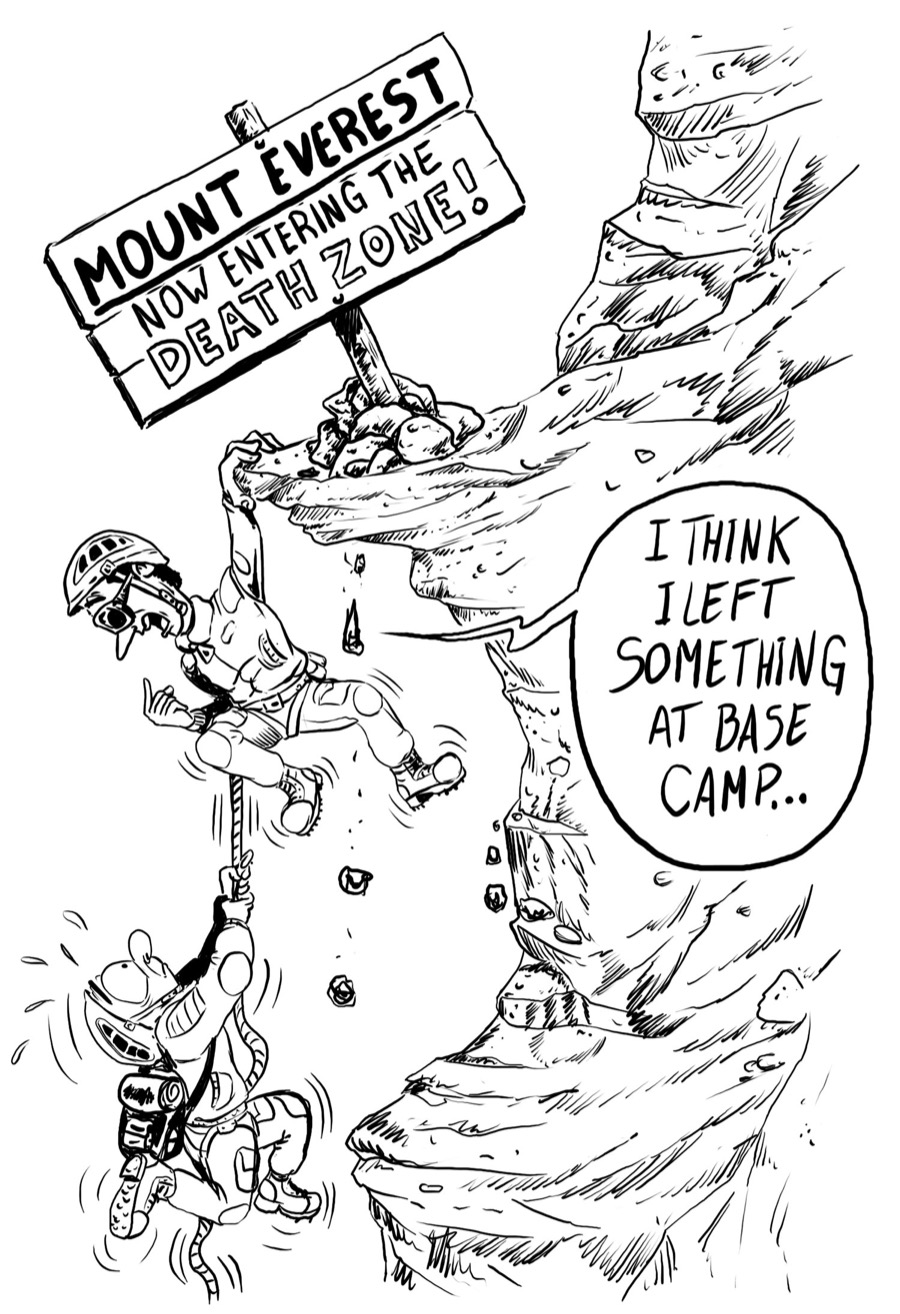
Everest’s peak stands at 29,029 feet above sea level, the cruising altitude of a commercial jet. Helicopters, by comparison, can only reach 25,000 feet before air becomes too thin to keep them airborne. At 26,000 feet, you only get one third of the oxygen as at sea level, making human life unsustainable for any significant period. At this altitude, the cells in our bodies literally start to die, which is why climbers refer to the top 3000 feet of Everest as the Death Zone.
On May 29, 1953, Sir Edmund Hillary and Sherpa Tenzing Norgay became the first two men to reach the peak of Mount Everest (both men refused to reveal who reached the summit first). By this point, more than a dozen men had already died attempting to summit Everest, including George Mallory, the British climber who, when asked why he wanted to reach the world’s highest peak, famously quipped, “Because it is there.”
The early mountaineers who tried Everest were among the best climbers in the world. But over time, the average skill level of those attempting the climb has gone down. Among the over 300 people who’ve now died on the face of Everest are quite a few hobbyists, climbers with minimal skills hoping to add their names to the list of those who stood, just for a moment, at the highest point on Earth.
Of course, no hobbyist climber could hope to summit Everest alone. To fill this demand, professional mountaineers have set up companies to guide hobbyists up the mountain. For years, people claimed these guides were tempting fate by bringing up unseasoned climbers. In 1996, fate caught up to them.
Jon Krakauer was covering the climb for Outsider magazine and recounts how some members of the expedition had only trained on StairMasters rather than on actual mountains and had arrived with brand new hiking boots they’d yet to break in. I won’t go into all the horrific details of the climb, but what kept hitting me as I read about the disaster was the long string of bad decisions that contributed to eight climbers failing to make it off the mountain alive, including three trip leaders who were all highly experienced.
Several of their mistakes were simply errors of timing. For instance, they neglected to send off the advance team at the predetermined time to set up the climbing ropes, causing delays during the ascent. When they reached the pre-determined cutoff time, when climbers were supposed to descend whether they’d summited or not, they kept climbing as leaders wanted to give all who paid a chance to reach the top.
The weather brought its own complications. The final ascent to the summit began at midnight on a clear evening with little wind. Dawn broke bright and clear, but by early afternoon, wispy clouds covered the peaks to the south. The clouds looked innocuous enough to the inexperienced eye, especially those unaccustomed to looking at storms from above. But one of the surviving climbers, a pugnacious Texan and long-time pilot named Martin Adams, later recounted to John Krakauer that “he recognized these innocent-looking puffs of water vapor to be the crowns of robust thunderheads immediately after reaching the top. ‘When you see a thunderhead in an airplane,’ he explained, ‘your first reaction is to get the f*ck out of there. So that’s what I did.’”
By mid-afternoon, the climbers found themselves in a full-blown storm. Besides bringing high winds and bitter cold, the storm also brought visibility down to nearly zero and erased the tracks the climbers had made on the way up. Indeed, one group simply got lost and failed to find the tents despite successfully navigating their way down to camp elevation.
Then there were physical ailments caused by the altitude. Another Texan, doctor Beck Weathers, suffered so much vision impairment the day before the summit ascent that he could only see a few feet and kept up with the group by stepping in the footprints of the climber ahead of him. Yet, unwilling to give up on his chance for a summit ascent, he kept the severity of his vision impairment to himself and attempted the final climb anyway. As the elevation increased, he found himself blind on the mountainside. His last day of climbing didn’t last long, but with no one available to escort him down, he waited on his own most of the day. Later, he descended with the group that couldn’t find the tents. While the others died of exposure during the night, Beck somehow survived, though his right hand, all the fingers on his left, and even his nose had to be amputated because of extreme frostbite. He recounts his ordeal in an autobiography entitled Left for Dead: My Journey Home from Everest.
Above and beyond the physical challenges of the mountain are the mental ones. In the Death Zone above 26,000 feet, mental processing is notoriously difficult. No doubt mental impairment contributed to several poor decisions made that day, but Jon Krakauer recounts one instance in particular for which he struggles to forgive himself. The first of the team to summit, Jon was already on his way down when he stopped to get himself another oxygen tank from a cache they’d set up in advance. Guide Andy Harris told him all the tanks were empty. Jon tried a tank, found it full, and headed down the mountain. Jon realized Andy’s regulator must have frozen, which made him think full tanks were empty. But between Jon’s poor processing at that altitude and his natural deference to the guide’s authority, he failed to point this out. Andy never worked it out on his own. He not only failed to get extra oxygen for himself, he convinced trip leader Rob Hall and others there was no oxygen available. And neither Andy nor Rob made it down alive.
The Everest disaster of May 11, 1996 is a perfect example of what we are not talking about in this book. To summit Everest and make it home alive, many, many things have to go right. One simple mistake, like failing to recognize a frozen regulator is giving inaccurate readings, can lead to multiple deaths.
In a case like climbing Everest, fear of failure can be an extremely healthy thing. Core to the Hurry Up and Fail philosophy is that failures are most effective as a tool when they occur quickly and when we take steps to minimize their negative consequences. In the following chapters, we’ll dig further into how to engineer our failures so they become low-risk, high-reward learning experiences.
Until then, stay off Everest.
