The Sociology Department at Brigham Young University had a shortage of professors during their summer term. This was in the late 1960s, long before the US had a glut of academics with PhDs scrambling to fill a handful of college teaching positions, and BYU struggled to find qualified candidates to cover for two of its professors on summer break.
Help came from an unlikely source; a downed airline pilot. Dr. Frank Adams received his PhD in Sociology from Columbia University and taught at City College in New York for two years before giving up teaching to become a pilot for TWA. However, an inflammation of the inner ear caused him to go on emergency medical leave, which he was spending in Utah. He hadn’t been expecting to get back into teaching, but with nothing else to do, he called the head of the department and applied for the position.
At his interview, Dr. Adams found the department head far more interested in his experience as an airline pilot (which, back then, was considered a much sexier job) than in his teaching credentials. That suited Dr. Adams just fine. In fact, his doctoral dissertation at Columbia had been on “The Sociological Impact of Aviation on Rural Populations of North America,” so he was intimately familiar with the crossover between flying and sociology.
Dr. Adams got the job and taught for the two summer semesters at a salary of $1600 per semester. The department heads were thrilled with his teaching, but didn’t have any open positions, so with regret they said goodbye to Dr. Adams at summer’s end, wishing him luck with his return to the skies. But Dr. Adams wasn’t only popular with the teaching staff. He’d also been a hit with the students, at least 50 of whom sought him out to tell them how much they’d enjoyed his class.
From the University’s perspective, that was the end of the story. Dr. Adams left Utah and never returned to teach again. Except it later surfaced that there was no Dr. Adams. Their summer substitute didn’t have a PhD from Columbia, nor had he ever been an airline pilot. He also was neither a doctor nor a lawyer, despite having worked in each of those professions. He was a high school dropout turned conman named Frank Abagnale, whose exploits became famous in the 2002 hit Catch Me If You Can starring Leonardo DiCaprio.
Several factors contributed to Frank Abagnale becoming one of the most successful conmen in US history. First, he looked unusually old for his age, allowing him to pass himself off as a professional even while still a teen. Second, he never worked with other criminals, which meant police couldn’t rely upon informants to track him down. Third, he was unpredictable in his behavior, jumping from one profession to the next rather than sticking to one consistent con.
What motivates a guy like Frank Abagnale to pose in so many professions? It certainly wasn’t the money. He made a fortune passing bad checks, and each time he conned his way into a new profession, he increased his risk of capture. In fact, reading his autobiography, I couldn’t shake the feeling that subconsciously he wanted to be caught, and it was that desire, alongside a thirst for adventure, that pushed him to try bolder cons as time went on.
Frank Abagnale was a true imposter. He worked as an unqualified doctor, an unqualified lawyer, and an unqualified university professor (though BYU disputes his claim to have taught there). True imposters like Frank Abagnale are extremely rare. Much less rare is Imposter Syndrome, which occurs when someone who’s truly qualified views themselves as a fraud. One study estimated 70% of people suffer from Imposter Syndrome at least once.
I’m no exception. When I first started writing, I’d feel uncomfortable when someone would refer to me as an author or a novelist. “Nah, I’m just playing around,” I’d say. “I’m not really much of a writer.” But as I released more books and built a growing fan base, I could no longer deny I’d become an author.
Why do so many of us look at ourselves as imposters even when the world looks at us as qualified? Is it humility? Perhaps, but fear likely plays a greater role. My favorite line from the Catch Me If You Can movie comes early on, soon after Frank runs away from home and turns to a life of crime. We hear Leonardo DiCaprio’s voice as he’s writing a letter to his father. “Dear Dad, you always told me that an honest man has nothing to fear, so I’m trying my best not to be afraid.”
Somehow, Frank Abagnale got over his fear of taking action despite being completely unqualified. He (and the rest of us) got extremely lucky he avoided any catastrophic disasters. In his book, also titled Catch Me If You Can, he details his near misses, such as when taking control of a plane while posing as a pilot and when treating a baby who couldn’t breathe while posing as a doctor.
So how can the rest of us, who are not conmen, get over our fears of taking action and the perception we’re frauds?
In 1999, Chris Baty decided to write a novel. It’s not that he had a specific idea, but he, quote, “wanted to write novels for the same dumb reasons twenty-somethings start bands.” Baty pulled down the shortest novel he had on his shelf, Aldous Huxley’s Brave New World, and did a rough word count. Estimating its length at 50,000 words, Baty decided that should be the shortest acceptable length of a novel, and set it as his goal.
Writing a novel can be an extremely long process. The first Harry Potter book took J.K. Rowling seven years to write. My first novel took me six. But Chris Baty wasn’t interested in starting a multi-year writing process. This was 1999, at the height of the dot-com boom. “Being surrounded by pet-supply websites worth more than Apple had a way of getting your sense of what was possible all out of whack,” he later wrote. Despite having zero ideas for a story, he gave himself only one month to complete his first novel.
To be fair, Chris’s idea of writing a novel in a month isn’t unprecedented. In April 1951, Jack Kerouac famously wrote a draft of On the Road in only three weeks. Kerouac typed so fast and furiously he couldn’t even handle the distraction of changing the paper on his typewriter and instead typed nonstop on a 120 foot scroll. But Kerouac had been playing with his story, based on his own life experiences, for years before his fingers hit those keys. Chris didn’t have so much as a story idea. And his audaciousness didn’t end there, for he had no intention of going through this mad process alone.
Chris recruited 20 friends to join him on his quest. Throughout the month, the group of them met in cafes after work to pump out the couple of thousand words they needed each night to reach their goals. Now before you get an image in your mind of Gertrude Stein, F. Scott Fitzgerald, and Ernest Hemingway meeting in the cafes of Paris in the 1920s and scripting works of shocking brilliance, let me set the record straight. That’s not where this story is going.
“Our combined post-elementary-school fiction output would have fit comfortably on a Post-it note,” Chris wrote. But that didn’t deter them. “The annals of rock ’n’ roll are filled with self-taught musicians who recorded albums first and learned how to play their instruments much later.” None of them cared they lacked experience; they were driven by sheer desire to become novelists.
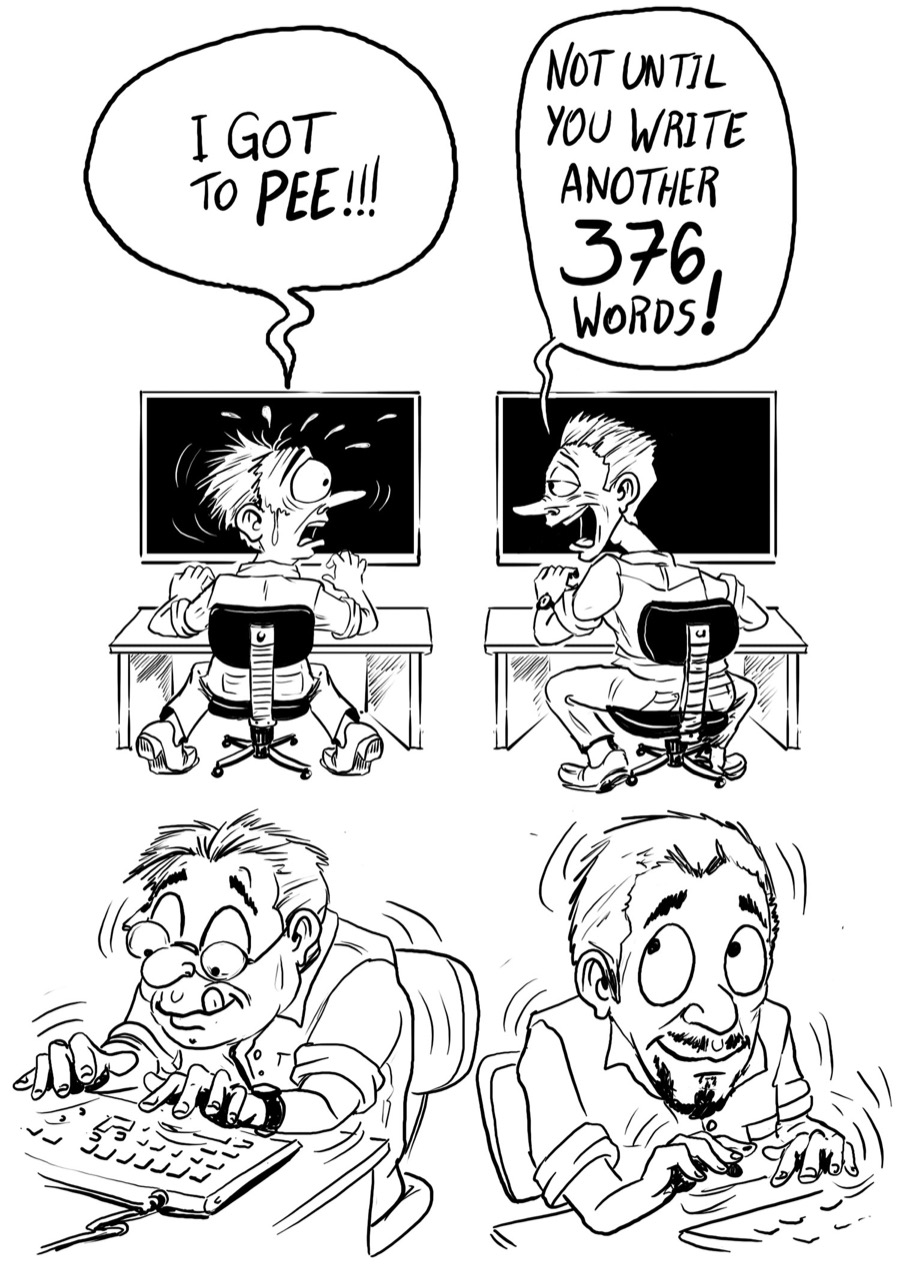
This rag-tag group of writers gave themselves word quotas and ran challenges and races. “Anyone who hadn’t reached their writing goal wasn’t allowed to get drink refills or go to the bathroom until they hit the mark. It was ridiculous, screaming fun, and the levity of those early sessions infused what would have normally been a terrifying endeavor—writing a book in an absurdly short amount of time—into a raucous field trip to Novel-land.”
The initial enthusiasm didn’t last. To hit the goal without losing their day jobs, the group had to dedicate virtually all their free time to writing. Perhaps the thrill of producing great works of literature would have been enough to carry them through, but the ugly truth was, “Our novels were bad. Maybe even horrible.” Half the group dropped out the second week. Those who stayed in mostly did so to save face after bragging about their plans to have a novel by the end of the month.
That came close to being the end of the story. There’s only so hard we can push ourselves toward crazy goals when they offer no compelling reward. Fortunately, “The listlessness of Week Two lifted, and the flat lines of our novels began to resemble the trajectories of honest-to-G’d story arcs.” And it wasn’t just the story arcs that changed. “The aimless, anemic characters we’d invented in the first fourteen days began to perk up and do things. Quirky, unexpected, readable things…It was as if our protagonists, tired of waiting for competent stage direction from us, simply took control of the show.”
On July 29th, the first participant crossed the 50,000 word finish line. Out of the twenty-one that started the challenge, six finished by the end of the month. “Everyone who participated in the escapade, though, came away from the experience changed by it.” For some, that change was just the realization they never wanted to write another book again. Others fell in love with the craft and took a huge step forward as novelists.
“For me,” Chris wrote, “the revelation I couldn’t shake was this: The biggest thing separating people from their artistic ambitions is not a lack of talent. It’s the lack of a deadline. Give someone an enormous task, a supportive community, and a friendly-yet-firm due date, and miracles will happen every time.”
Far from being discouraged by the results, Chris realized he’d stumbled upon something big. As he writes in his book, No Plot? No Problem! A Low-Stress, High-Velocity Guide to Writing a Novel in 30 Days, “Thanks to the go-go structure of the event, the pressure to write brilliant prose had been lifted. And in its place was the pleasure of learning by doing. Of taking risks, of making messes…Writing for quantity rather than quality, I discovered, had the strange effect of bringing about both…The roar of adrenaline drowned out the self-critical voices that tend to make creative play such work for adults.”
The following year, Chris moved his contest to November “to more fully take advantage of the miserable weather.” His recruitment jumped to 140 participants, 21 of whom reached the 50,000 word finish line.
Chris eventually branded his initiative NaNoWriMo, short for National Novel Writing Month. By 2007, 100,000 people signed up to be Wrimos (as participants are now called) and over 15,000 of them completed 50,000 word books. A decade later, the number of Wrimos surpassed 400,000.
I joined NaNoWriMo for the first time in 2014, immediately after the publication of my first book, The Lamp of Darkness. I was eager to make headway on the sequel, The Key of Rain, and I knew my first drafts work best when I write without editing myself. This is sometimes referred to as a “vomit draft.”
Each day after I wrote, I entered my word count into my profile page on NaNoWriMo, and it told me whether I was on track to become a NaNoWriMo Winner. To win, all you have to do is hit the 50,000 word goal. As Chris says, NaNoWriMo isn’t about quality as much as quantity.
So how did my first NaNoWriMo experience turn out? By November 30, 2014, my novel still wasn’t good, but I hit the 50,000 word goal and received a badge showing I was a winner! It took me almost four years to finish crafting The Key of Rain into a novel I could be truly proud of, but there was no question the NaNoWriMo platform, with its software, checkins, badges, and prizes was great fuel for getting the work done.
There are local Wrimo support groups and meetups around the world each November. The only time I went to an in-person meetup, six of us met at a local cafe. We had time for bantering ideas, silent periods for focused writing, sprints for hitting a certain word count in a fixed time, and contests where the moderator would throw out some bizarre element and tell us we all needed to fit it into the next segment of our story (I backed out of this last one as it’s extremely difficult to work an iPod into a work of Biblical fiction).
I love the NaNoWriMo example as it’s a Hurry up and Fail machine. Let’s quickly unpack a few of the elements that make it so effective:
- Audacious Goals: It’s easier to get fired up when there’s a clear, audacious goal you’re trying to reach. Writing 50,000 words in 30 days certainly qualifies as audacious.
- Social Proof: You don’t want your goal to feel out of reach. In the NaNoWriMo community, hundreds of thousands have already hit the 50,000 word goal. This gives you the social proof to know the goal is attainable.
- A Clear Deadline: You have until November 30th at midnight to complete your novel. As Chris points out, there’s tremendous motivation in a deadline.
- Measurable Milestones: Each day, you receive clear feedback about your pace, so you know if you’re on target to reach the goal and how much you need to adjust if you fall behind.
- A Supportive Community: Doing the challenge along with hundreds of thousands of other Wrimos makes the process fun, provides accountability, and takes the pressure off. As much or as little support as you want is available within NaNoWriMo forums.
- Rewards: Win NaNoWriMo and you’ll get a badge you can post on social media to show friends you’re a winner. You can also receive discounts from NaNoWriMo sponsors when you win, such as a 50% off coupon for Scrivener, the software I’m currently using to write this book.
Of course, NaNoWriMo is more about the experience than the end product. While Wrimos hope to grow as writers and make real headway on their books, none claim it’s a recipe for creating a bestseller. But what if you’re not satisfied just producing junk quickly? What if your vision is to create something substantial, such as a great company?
In the next chapter, we’ll have a look at how the Hurry up and Fail ethos is transforming the business world, particularly amongst innovative startups.
