In 1999, Nick Swinmurn, the founder of ShoeSite.com, had what he thought was a brilliant idea but couldn’t get anyone to listen. Shoe sales generated $40 billion each year in the United States, but hardly any online. Nick saw a billion dollar opportunity for a shoe website, but he faced two challenges:
- Selling shoes requires an enormous capital investment because stores must stock each shoe in many sizes. Inventory on its own might not have been a deal killer because this was still before the dotcom bubble burst, when venture capitalists were pouring millions into even moderately good ideas.
- Most investors thought Nick had a horrible idea. No one would buy shoes online, they claimed, because shoes are a product customers need to try on before buying.
Nick was caught in a classic Catch-22. To prove to investors that customers would buy shoes online, he needed to build a website and generate substantial sales. But to build that website and prove sales, he needed investment money to cover his inventory costs. What was he to do?
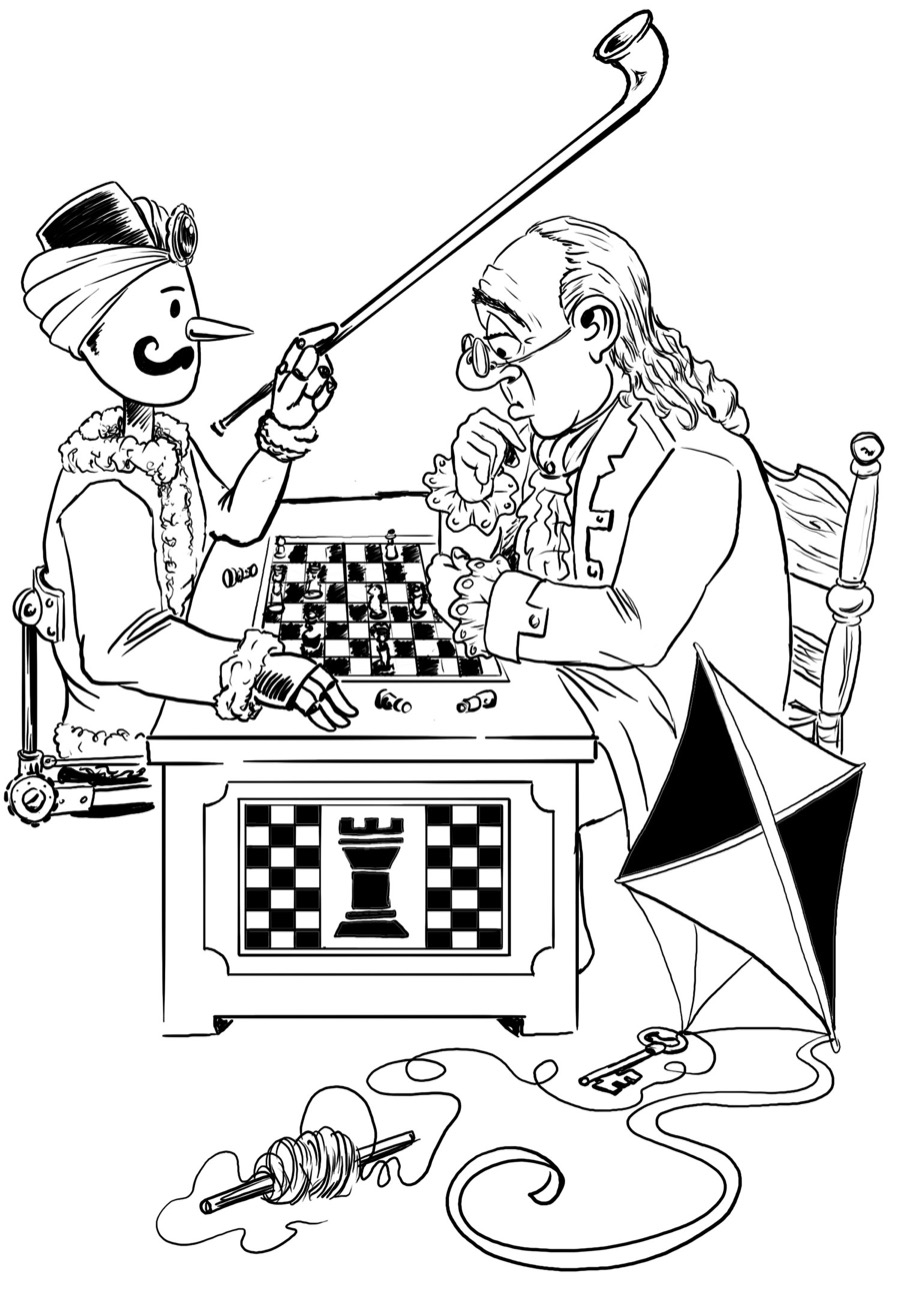
To find the answer, let’s jump back in time to 1783 when Benjamin Franklin, then serving as the US Ambassador to France, played a most unusual game of chess. His opponent had a dark beard, grey eyes, wore traditional Ottoman robes and a turban, and held a long Turkish smoking pipe in his left hand. He was also made of wood.
Constructed in 1770, the Mechanical Turk was presented to the world as an automaton by Hungarian inventor Wolfgang von Kempelen. Automatons were all the rage in the 18th century. They were mechanical robots that, when wound up, could perform a range of rudimentary tasks. A cuckoo clock chirping on the hour is a classic example. But the Mechanical Turk was in a category all its own. It didn’t just perform a set of predetermined tasks; it played chess against human opponents, showing the ability to think. In their match in Paris, the Mechanical Turk defeated Franklin, one of the greatest intellectuals in US history.
At the start of each exhibition, Von Kempelen opened the wooden cabinet under the chess board to show the audience the empty cavity and the clockwork machinery inside. Then he closed the cabinet and wound the mechanism with a key. The Turk was then ready to face off against its human challengers.
The Mechanical Turk toured Europe for 84 years under multiple owners, stunning audiences, until its eventual destruction by fire in 1854. Only then did Dr. Silas Mitchell, the son of the Mechanical Turk’s final owner, reveal its secret. In an article in Chess Monthly, Mitchell wrote, “No secret was ever kept as the Turk’s has been. Guessed at, in part, many times, no one of the several explanations in our possession has ever practically solved this amusing puzzle.”
The Mechanical Turk was not, as many at the time believed, a machine capable of out-thinking a human opponent. And to his credit, Von Kempelen himself never claimed it was, presenting it only as an elaborate illusion. Showing working gears inside the cabinet, winding the Turk, and other effects, including a machine that generated a clockwork sound when the Turk moved, simply helped maintain the illusion. In actuality, the cabinet had a secret compartment where a chess master could both observe the moves on the board and operate a series of levers to make the Turk respond.
The story of the Mechanical Turk probably would have remained a mostly forgotten historical footnote had it not been for Jeff Bezos and Amazon. In November 2005, the e-commerce giant launched a new service of their own called Mechanical Turk, or MTurk for short. Amazon described its new service as artificial artificial intelligence. Amazon’s Mechanical Turk is a distributed labor tool that involves crowdsourcing workers (known as Turkers) to perform Human Intelligence Tasks (known as HITs) in a way that feels, as with the original Mechanical Turk, almost machinelike. A typical HIT might involve auditing user-uploaded content to make sure it’s appropriate, classifying objects in satellite imagery, or converting unstructured data into standardized forms.
In 2006, artist Aaron Koblin toyed with the platform and had it generate something distinctly human. He created an online drawing tool and had Turkers use it to “draw a sheep facing left.” Koblin collected 10,000 sheep this way, paying a mere $0.02 per sheep. But he didn’t just want the sheep at the end, he also wanted to watch the Turkers creating their sheep, to see the creative process in action. Turkers, on average, took 105 seconds to draw their sheep, meaning they only earned an average wage of $0.69 per hour. Koblin turned his sheep into a website, an exhibit, and a collection of stamps. Not bad for $200 in Turkers’ fees.
Other uses of MTurk feel far more mechanical.
Business cards have been around for hundreds of years. The Chinese first started using calling cards as early as the 15th century, and precursors to the modern business card existed as early as the 17th century. The cards are still in use today, even though our shift to digital communication has made the paper cards as much a nuisance as anything else.
This was the challenge the founders of CardMunch attempted to tackle in 2009. They envisioned an app whereby iPhone users could scan business cards with their phone cameras and digitize them. The problem was Optical Character Recognition (OCR) technology was not yet strong enough to interpret the range of fonts and designs used on business cards. The CardMunch team could have waited a couple of years for the technology to catch up, but if they did, they would have lost their early-mover advantage.
So the CardMunch team got creative. Users scanned business cards into their phones, and a bit later, the system sent them a notification that their cards were digitized. Most users no doubt assumed CardMunch had developed cutting-edge OCR technology that was highly effective if a little slow. In reality, the images went to MTurk where real humans read the cards and transcribed the data. Does this business model strike you as hugely inefficient? It was, but it didn’t matter.
The CardMunch model is known in business circles as a Wizard of Oz paradigm, a term coined by J.F. Kelly 30 years before the CardMunch launch. Just as the Wizard of Oz remained hidden behind a screen, pulling levers and appearing to be far more powerful than he was, the Turkers played the role of a highly advanced technology that didn’t exist.
Had CardMunch planned to use human power long term, investors would have balked at the inefficiency of the business model. But CardMunch only needed human capability to prove market interest, showcase their concept, and serve as a stopgap until OCR technology improved. The Turkers provided a cheap, fast way to get a giant jump on competition. A couple of years after launch, LinkedIn bought CardMunch for $2.4 million. Two years later, LinkedIn switched to an OCR model once the technology caught up.
The Wizard of Oz paradigm allows you to test your ideas efficiently without users ever knowing you’re cutting corners.
Let us return to our story of Nick Swinmurn and ShoeSite.com. Nick badly needed a Wizard of Oz solution that would give ShoeSite.com the appearance of a million dollar inventory without requiring him to have the million dollars. Nick didn’t need to make profit on these initial sales, just answer the all-important question: will customers buy shoes online?
To prove his concept, Nick opened ShoeSite.com without purchasing a single pair of shoes. Instead, he went to the local mall and asked shoe retailers if they’d allow him to take pictures of their shoes and post them online. Since he wasn’t out for short-term profit, he could fulfill these orders (if any actually came in) by going back to the stores, purchasing their shoes at retail, and shipping them out to his buyers. Yes, he’d lose money on each sale, but it was a small cost to prove whether he had a viable business model. It was worth spending a few thousand dollars to potentially procure millions from investors.
It didn’t take long to receive enough sales to prove Nick’s concept. A short friends-and-family funding round soon gave way to venture capital money. Normally, venture capital investors fund the existing leadership team and relegate themselves to an advisory role. Here, the venture capital investor and Nick agreed to a role reversal. Thus, investor Tony Hsieh took over Nick’s role as CEO of the rebranded Zappos. A decade later, Amazon acquired Zappos for $1.2 billion.
The Wizard of Oz paradigm is one of three models we’ll explore under the larger umbrella of Minimum Viable Products (MVP). In recent years, the venture capital world has become obsessed with MVPs. When funding startups, investors no longer want to dump tons of money into creating a complete product with a full range of bells and whistles before releasing it to the marketplace. Rather, they want to quickly set a product loose for public feedback. The new gadget or service still needs to function — they don’t want to release buggy software — but it doesn’t need to be comprehensive.
As we saw with ShoeSite.com, the MVP doesn’t need to be profitable, sustainable, or even fully functional as long as it provides sufficient insights to direct new stages of funding and development. The goal is to be fast, cheap, and effective. Minimum Viable Products are all about Hurrying up and Failing to prove a business model, secure funding, or build an audience.
Let’s examine two other MVP models used to Hurry up and Fail.
In 2000, Joe Gebbia was a freshman at the Rhode Island School of Design. After sitting for an 8-hour long critique, known as a crit, Joe found himself with a mighty sore butt. As his classmates stood up to leave, he noticed charcoal on the bottoms of their pants from sitting on dirty art studio surfaces. These observations led Joe to create CritBuns, portable foam seat cushions shaped like butt cheeks to keep art students comfortable and their pants clean during long crits.
As this book demonstrates, failure can often be a good thing, and it certainly was with CritBuns. Had CritBuns been even a minor success, Joe might have had slightly more cash on hand a few years later when living in San Francisco. And if he had a bit more cash, he might not have felt desperate when his landlord raised his rent by 25%. And had he not felt desperate, he might not have taken desperate actions and stumbled upon a truly gigantic breakthrough. Fortunately for Joe, CritBuns were a flop. Over fifteen years after he created them, Joe still had stock and would personally go down to his basement and ship one out every time a CritBun sale trickled in, even though by this time, Joe was a billionaire.
Let’s return to Joe’s rent crunch. Desperate to come up with more cash, Joe and his roommate Brian tried to capitalize on a large design conference coming to San Francisco, which left hotels booked solid. They pulled three air mattresses out of their closet and posted on the conference website that attendees could rent an air mattress close to the conference for $80 a night. They even built a quick website advertising their offering and called it Air Bed and Breakfast.
These days, the AirBNB website is a pleasure to search through. I love using the map view that allows me to drag the map around a city and zoom in or out to find accommodations in precisely the location I want. I can select dates, desired number of bedrooms, price ranges, and determine if I want shared accommodation or an entire home. I can read reviews of homes and hosts, and the system stores my credit card information, allowing for easy checkout.
Back then, the Air Bed and Breakfast website had none of those features. This wasn’t a Wizard of Oz scenario where Joe and Brian magically hacked together something which looked to their customers like a fully functional, professional travel site. This was the exact opposite. It was a down and dirty, bare-bones web page that just gave the critical information. It didn’t even have credit card processing. Everyone who stayed with Joe and Brian paid in cash. This type of Minimum Viable Product is sometimes called the One Painkiller method. As the name implies, the One Painkiller method doesn’t try to be a complete solution. Instead, it focuses on solving one pain-point, in this case that conference attendees couldn’t find enough places to stay. Pains are easy to identify, their remedies often aren’t. Here, the proposed painkiller was highly speculative. Would people pay money to sleep on an air mattress at the home of complete strangers?
The first clinical trial showed promise. Joe and Brian successfully rented out all three air mattresses. But here’s a note of caution for anyone creating an MVP: Make sure you have sufficient evidence to determine if your product is actually viable. Three guests offered Joe and Brian encouragement, but were not enough to prove anything.
They recruited a former roommate, Nate, to help program the site. At this point, they considered Air Bed and Breakfast a way to provide extra housing for large conferences. They prepared for their big launch at South by Southwest, which occurs each year in Austin, Texas. This second test was a bust. Rather than scaling up from their initial experiment, all their efforts to target South by Southwest resulted in only two bookings, seriously challenging whether their idea could succeed.
The AirBNB story now takes a bizarre left turn. The partners were discouraged, cash poor, and desperately seeking an idea that would bring more enthusiasm and revenue to the business. Since the site was called Air Bed and Breakfast, they thought to manufacture breakfast cereal for their hosts, hoping the cereals could increase their value proposition. This idea didn’t last long. A quick look at the costs involved convinced them it was a horrible idea. But the roommates moved forward with a slightly modified version: making proprietary cereal boxes and filling them with existing cereals. Specifically, with the presidential elections coming up, they created limited edition boxes of Obama O’s and Cap’n McCains.
Shockingly, these political cereal boxes were a huge success. They won the struggling team national press coverage, which yielded a strong showing at that year’s Democratic Convention in Denver. The cereal boxes also helped in another respect. The AirBNB crew hoped to get accepted at Y Combinator, the premier venture capital incubator. The heads of Y Combinator didn’t think the idea of renting out accommodation in stranger’s houses was a good one, believing people were too fearful to make it work. However, as an early stage incubator, they’ve learned to put more stock in entrepreneurs than in their specific business ideas because strong entrepreneurs can always pivot to stronger business models. Despite not liking the AirBNB concept, the cereal gambit convinced Y Combinator to take a chance on AirBNB because it showed the founders had the grit and creativity they were looking for, even if their idea seemed stupid.
But even those who thought they had a ridiculous idea couldn’t deny it actually made money in its initial trials. Getting a website up fast, testing it, and tweaking it allowed them to develop the powerful platform they have today. By using the One Painkiller process, the AirBNB founders proved within just a few days that at least one aspect of their business plan could work. Once upon a time, investors couldn’t fathom AirBNB competing with hotels. Now, they have more rooms than the largest hotel chains in the world.
So far, we’ve looked at two types of MVPs: the Wizard of Oz and the One Painkiller. But not all products can be shoved into one of these modalities. Take, for instance, the development of a new car. You can’t exactly Wizard of Oz the customer into buying an illusion of a car that doesn’t exist. Nor can you easily create a car with just one key feature, as in the One Painkiller technique. So what do you do then?
In 2006, Drew Houston took the notorious Fung Wah bus to New York to visit friends. The Fung Wah ran between Boston’s South Station and New York’s Chinatown for a fraction of the cost of mainstream bus lines. A quick scan of Fung Wah reviews includes: “Cheap and frequent but crappy and potentially deadly;” “Probably the cheapest way to commit suicide. Some of their drivers don’t even have a valid driver’s license;” and “Expect the ride to be worse than a roller coaster.”
But despite the hazardous conditions, the Fung Wah remained popular with students and others with limited funding who found the $10 to $15 ticket price a bargain. With little in his pocket after graduating from MIT, Drew preferred the cheap prices to riding on a bus line that didn’t falsify its safety inspection reports.
Just as the Fung Wah pulled out of South Station, Drew had the horrible realization he’d left his thumb drive behind. Back in 2006, if you wanted to share data between your computers, the most convenient way was via a USB thumb drive. Without his drive, Drew had no way to access his data and do his intended work. He never wanted to be stuck in this situation again, and right there on the Fung Wah, he pulled out his laptop and started coding a solution to his problem.
Drew envisioned a cloud-based platform which could sync files so they’d be accessible from anywhere. That way, if he forgot his thumb drive or if it got destroyed when the Fung Wah caught fire (not as uncommon as you might think) he could still access his data with an internet connection. Also, if his laptop were stolen or even crushed the next time the Fung Wah rolled over (also happened), Drew’s data would be safe and could quickly be downloaded onto his new computer.
It didn’t take Drew long to develop a working prototype. The problem was, his business model was resource heavy. He wanted to create off-site storage for the internet, which would require tremendous server space. And it wasn’t just space he needed. His premise was based on keeping user data safe, meaning his system needed to have exceptional security and stability. So while building a prototype for one person for testing purposes was quick and inexpensive, scaling the business to service millions would cost a fortune.
Drew knew his best bet was to procure serious venture capital funding. Just like Joe Gebbia and AirBNB, he set his sights on Y Combinator. A friend there got him in front of Paul Graham, the managing director, and Drew showed up with his laptop and tried to demo the product for Paul. Big mistake. Paul threw Drew out on his ear without looking at the demo. He said the whole reason they had an application process was so they wouldn’t have people showing up off the street trying to pitch them.
Now Drew was in a tough spot. A day earlier, he’d been a nobody to Paul Graham. Suddenly, he was worse than a nobody. He was on Paul’s blacklist. Drew needed to reverse his fortunes. He wanted to get Pau’s attention and convince him he was a guy worth dealing with. But how?
So far, we’ve explored two models of the Minimum Viable Product, but neither of those was a good fit. Drew couldn’t launch his product using the Wizard of Oz paradigm. He needed to actually save users’ data securely, not just appear to. The One Painkiller technique was also a no-go. Unlike AirBNB, which launched with an extremely basic website created in just a few days, Drew’s product required elaborate and expensive server infrastructure to go live with even its most basic features.
After being run out of Paul’s office in disgrace, Drew realized venture capitalists like Paul spent much of their day following Hacker News and other sites reporting on the latest in technology. If he could create enough buzz on Hacker News, he might restore his dignity and get the Y Combinator team chasing after him. He didn’t actually need any users to try out his product, he just needed enough people to understand and get excited about his concept.
Next to the Wizard of Oz paradigm and the One Painkiller technique, Drew’s chosen method seems incredibly simple. For his MVP, he simply created a video demonstration of his product, which he’d titled Dropbox. This video was nothing more than a screen capture of Drew using Dropbox on his computer, accompanied by Drew’s voiceover walking the viewer through its functionality.
The result?
The tech world went nuts. Drew’s video shot up to the top spot on Hacker News and stayed there for days. No one had ever seen a service quite like Dropbox before. Many wanted to sign up on the spot, but they couldn’t, as the service didn’t yet exist. Instead, viewers were taken to a page where they could leave their email to join the waitlist for early access to Dropbox.
Dropbox shot from a complete unknown to a tool techies drooled over but couldn’t get. Within 48 hours, everyone who mattered in Silicon Valley venture capital firms had Dropbox on their radar, including Paul Graham. The long email list of those who signed up for an early shot at Dropbox proved a tremendous market demand. That demand got Drew into Y Combinator and secured the funding he needed to launch. The huge waitlist allowed him to grow the service gradually, giving access to just as many users as he could handle for each stage of development.
Some might think Drew’s explainer video wasn’t an MPV at all since it didn’t involve a product release. But remember, the point of an MVP is not sales or profitability; it’s feedback. Drew’s explainer video conveyed to potential customers exactly what his product would do. Viewer response could have been critical or, worse, silent. Such results would have sent him back to the drawing board to make tweaks and try again. Instead, he received a clear message he was on track.
Elon Musk used this same technique on November 22, 2019, when he announced the release of the new Tesla Cybertruck. If you haven’t seen the Cybertruck, it’s a pickup shaped like a chrome and glass pyramid that belongs in a sci-fi movie.
To show the hardness of its stainless steel alloy exterior, Musk pounded the Cybertruck with a sledgehammer, which didn’t leave a mark. Then an assistant threw a metal ball at the windows to show the strength of the “armor glass.” This time, the live demo was a failure, and the glass cracked. But as we’ve learned throughout this book, failures aren’t always the disasters they seem. In fact, the cracked window gave the Cybertruck live demo so much publicity that some speculated Musk did it on purpose (since Musk swore on stage when the window cracked, I don’t think it was intentional).
Still, Musk laughed off the failure and kept going with the demo. He wowed the audience with the truck’s speed: going from 0 to 60 in only 2.9 seconds; its range: up to 500 miles on a single charge; and its price: coming in at under $40,000 for the base model.
Of course, the real test of the demo wasn’t whether the glass broke, but how many people would put their money where their mouth was. The day of the demo, 146,000 people made a deposit to pre-order a Cybertruck.
The incredible thing about the Cybertruck demo was that Tesla didn’t intend to kick off production until the end of 2021, a full two years later. But the demo proved a healthy market for the product, created tons of buzz, raised tens of millions of dollars in paid deposits, and boosted the stock price.
The point of this chapter is not to detail all varieties of Minimum Viable Products. A quick online search will reveal more variations. The point is to show the power of quickly and inexpensively putting your ideas out to generate genuine feedback and a way forward.
Imagine for a moment Joe Gebbia and his partners had created and stuck to a five year plan for AirBNB. Had they kept their heads above water, they would have wound up with a business offering air mattresses to conference attendees rather than becoming the world’s largest hotelier. Their success came from making iteration after iteration, each time seeing what was working and what wasn’t, and adapting to the feedback of their hosts and customers.
The MVP ideology is all about speeding up the feedback loop. Don’t spend two years constructing a great vacation rental website when you can hack together a basic website in three days that will still solve your customers’ number one pain point. The initial AirBNB website didn’t need to accept credit cards or have a map view in order to answer their primary question: Would people pay to stay at a stranger’s apartment?
For AirBNB, the One Painkiller technique gave them fast, concrete feedback. Zappos used the smoke and mirrors of the Wizard of Oz paradigm, and Dropbox made a quick and dirty product demo. All three companies received feedback in a matter of days that could have taken years had they used the more traditional route of waiting for a fully functional product to launch.
Do you also have a product or idea you’re excited to release to the world? Which Minimum Viable Product techniques can speed up your feedback loop? Here are a few things to consider when designing your MVP.
- Identify your target market. Who exactly is your MVP meant to serve?
- Define the core problem your MVP will solve. An MVP shouldn’t be everything to everyone. Focus on one core issue.
- Select the key features. Avoid adding any extra features that aren’t critical to your MVP.
- Set clear objectives. This is what your MVP is trying to prove or disprove. Will people buy shoes online? Will people pay money to stay in someone else’s home?
- Collect feedback. How will you know if your idea is a good one or not? What does success look like? Feedback is essential and later in the book, we’ll examine ways to effectively gather and evaluate it.
- Iterate quickly. You may not get a clear ‘yes’ or ‘no’ on your first try. Use the feedback to make improvements and keep putting out new versions.
- Keep costs low. Remember, an MVP should be a low-cost test of your idea.
But what if you just don’t feel ready to put your idea out into the world because you’re afraid the public will reject it? If fear is blocking you from moving forward, I have news for you. You’re not alone.
