If the Feds caught Roger counterfeiting one more time, they were going to lock him up and throw away the key. But Roger was a counterfeiter to the bone and wasn’t about to give it up for a legitimate job. He just needed a better strategy, one that wouldn’t raise the ire of the Treasury Department.
This was in the late 1950s, well before frequent flyer miles and cash back credit cards. Back then, there was one giant customer rewards program that dwarfed all others: S&H Green Stamps. At its peak, S&H claims it was printing 3 times as many stamps as the US Postal Service, and 80% of households collected them. You could buy nearly anything with their Green Stamps: appliances, cars, vacations, even a pair of gorillas (the gorillas were donated to zoos).
Unlike dollars, which were difficult to copy, Roger realized the Green Stamps were moronically simple. He could make counterfeits indistinguishable from the real thing. And these stamps weren’t under the jurisdiction of the feared Treasury Department. In no time, Roger could print millions of them, and anything in the S&H catalog could be his.
There was only one problem. The glue Roger used wouldn’t work in his licking machine, and he had to lick each stamp to put it into the redemption books. Picture this: Roger the counterfeiter becomes a victim of his own success, making himself sick and slowly withering away as he licks and pastes stamp after stamp in his redemption books. Meanwhile, his mother is negotiating with S&H on how many books of stamps they’d need to redeem for a new house in the suburbs. A tempting reward for her, a potential death sentence for him.
If the above storyline reminds you of the warped plots of Stephen King, that’s because it is. A very young Stephen King. While not the first story he ever submitted for publication, this was the first he considered a strong, original idea. He wrote up Happy Stamps and submitted it to Alfred Hitchcock’s Mystery Magazine. Three weeks later, the story came back with a rejection slip. At the bottom of the slip was a handwritten note telling him not to staple his submissions in the future. That’s all the feedback he received, not a word on the rejected story.
Plenty of young writers have submitted stories to magazines and received similar rejection slips. In fact, while taking a creative writing course in college, one of my professors insisted we all submit stories for publication just so we could know what it felt like to receive a rejection letter. When we asked him about what would happen if our stories were accepted, he assured us we had nothing to worry about. None of us yet had the skill to be published.
The rejection letter I received in that class was the last I received for years. Not because I was so good, but because I stopped writing when the class ended. I in no way thought my writing was good enough to have a future as a writer, and the rejection letter proved I was right.
I wonder how many thousands of young writers submit exactly one story for publication their entire lives? They then await the publisher’s verdict: do they have the skill to be real writers or are they just pretending? When their first rejection letter inevitably comes in, the little voice in the back of their heads has all the confirmation it needs. They’d tried, they’d failed. It was time to give up writing and apply for law school.
But when Stephen King got his rejection letter for Happy Stamps, he didn’t conclude the publishing world had deemed him forever unworthy. Instead, he pounded a nail into the wall above his Webcor phonograph, wrote “Happy Stamps” on the rejection slip, then poked it onto the nail. He recalls in his book On Writing, “I felt pretty good, actually. When you’re still too young to shave, optimism is a perfectly legitimate response to failure.”
King’s rejection nail didn’t last long. Not because he was so good no one turned him down. As he recounts, “By the time I turned fourteen (and shaving twice a week, whether I needed to or not) the nail in my wall would no longer support the weight of the rejection slips impaled upon it. I replaced the nail with a spike and went on writing.”
There are times I’ll read passages in Stephen King’s 11/22/63 (one of my all time favorite books) and just shake my head, wishing I could write like that. I remind myself King wasn’t born with a genius for description or character development. He pumped out enough stories by age fourteen that the rejection slips alone overwhelmed a nail. Not only did he Hurry Up and Fail, he shifted rejection from a negative to a positive, to something that could propel him to work harder rather than drag him down.
As we saw in Part 1, when we view trial and failure as a positive rather than a negative, we open the floodgates to learning and growth. But there’s a subset of failure that most of us find particularly difficult to handle: rejection. I might try my hand at baking a cake and if it comes out lousy, I can just dump it in the trash and move on. But with rejection, I’m no longer the judge of my worthiness. I pass that power on to another. And most of us hate to be judged, largely out of fear that we’ll be rejected.
Stephen King moved toward rejection rather than shunning it, and as a result, he accelerated his growth as a writer. How is your ability to handle rejection? Could you imagine getting rejection after rejection and keep moving forward with the same optimism and determination?
If your answer is no, beware. It’s going to cost you.
Women, on average, earn 81 percent of what men make in the United States. Some look at this number and conclude there’s clear gender discrimination in the workplace. Others say, ‘not so fast,’ and point out that most of the gap can be explained by career choice, as fewer women want to work high-intensity, high-pay, 60-hour-a-week jobs. Many women intentionally choose lower paying careers that provide greater work/life balance.
So can career choices alone explain the gender wage gap? Not entirely, no. There is another aspect of the pay gap that is rarely discussed in the debate and has nothing to do with differing career paths.
In 2020, I interviewed Bernadette Joy as part of a virtual summit I ran called Financial Independence School. Bernadette (who I always think of as Burn-a-Debt) has spent over a decade in HR and now runs Crush Your Money Goals, helping women pay off debt and get ahead financially. She explained another aspect of the wage gap I’d never considered.
“During my time in HR, I’d say the majority of men I made job offers to made a counteroffer asking for more money. But most of the women I made offers to took it right away. I can probably count on one hand the number of women who negotiated.”
Personally, I’d never worked in corporate America and I knew little about pay structures or how salaries were determined. So I asked, “Can you give me an example of a man who successfully negotiated?”
“Sure,” she said. “I remember one guy. He was just coming out of college. We made him an offer for $80,000 a year, which I thought was a ton. He told me he wanted $140,000. I thought he was crazy, but I told him I’d pass along the request to my manager. The manager said, ‘we’ll meet him at $120,000,’ and my jaw hit the floor.”
“So he got 50% more just for asking for it?”
“Yep.”
But surely there must be risks to negotiating, right? I asked Bernadette, “In all your years in HR, did you ever rescind a job offer because someone negotiated?”
“No.”
“And what percent of the time did those who negotiate end up making more?”
“The majority of the time they wound up making more.”
Stop and think about that for a moment. Here is an HR veteran telling us negotiating had tremendous upside and absolutely no financial downside. And yet, the vast majority of women didn’t do it. Why? Culprit number one is the paralyzing fear of rejection. If we don’t ask, we won’t have to suffer the indignity of being turned down.
Hear this now: Those who can’t handle rejection settle for less. If you can’t ask for more money, you might get paid less than another doing the exact same job. If you can’t handle asking someone on a date, you might have to settle for less love in your life. If you can’t ask for a promotion, you may have to settle for advancing at a slower rate than others with less talent.
To further illustrate, here’s a quick snippet from The Size of Your Dreams, a novel my wife and I wrote to teach readers techniques for achieving their goals.
“What separates great salespeople from ordinary ones?” Mr. Griffin asked.
Christy shrugged. “I suppose it’s the ability to get people to say yes.”
“That’s the second greatest distinction. More important is the ability to hear the word no.”
“How does that help?” Jarod asked.
“Ordinary salespeople go out on a sales call, and if they get a no, they get discouraged. The great ones hear no after no and keep going. Some even tell themselves that they need to hear no ten times to get one yes. Getting a no actually excites them, as they tell themselves that it brings them closer and closer to getting a yes.”
Rejection is like a muscle. A person who lifts a 50 pound weight once in their life might be sore for days afterwards. But someone who pumps iron every day won’t even notice it. Stephen King had to move from a nail to a spike to hold his rejection slips, but he plugged away and became one of the bestselling authors in history.
So I want to ask you again: where do you stack up in terms of rejection? Are you someone who has no problem asking for what you want? If you get rejected, can you just shrug it off and move on?
If you’re like most people, my guess is you don’t always feel comfortable asking for what you want. Even worse, when you do ask and get rejected, I bet it stings with humiliation and shame. The question is, can you live with momentary discomfort if it’s the key to getting what you want in life?
What if I told you it was possible to reduce or even eliminate that discomfort, so it never gets in your way?
Jia Jiang was six years old when his teacher decided to encourage her elementary school students to give compliments to their classmates. One by one, the students received praise from their peers, but none of them volunteered any compliments about Jia. The humiliation he felt that day would haunt him for decades.
Twenty-four years later, Jia still couldn’t shake the fear of rejection he traced back to that early childhood event. At this point, he was married, with a child on the way, and had left his high-paying job to build his own startup. But that old fear threatened to sink the fledgling business. He’d only gotten up the nerve to approach a single investor to back his startup, and when the investor said no, he was ready to quit.
But his wife wasn’t ready to let him give up just yet. “I gave you six months, I didn’t give you four,” she said to him, referring to their agreement that he could take six months without a job to try starting his own business. “You have two months left. Keep going and leave no regret!”
So there Jia found himself, with two months to secure an investor, but with a debilitating fear of rejection blocking him from reaching out. To save his business, Jia realized he needed to stop running from rejection and start co-existing with it.
His online search for how to overcome rejection eventually led Jia to Rejection Therapy, a card game created by Canadian entrepreneur Jason Comely. The game is simple: you pick a card and must do whatever it says. One card requires you to walk up to a stranger and convince them you know them. Another has you submit a pitch to Dragon’s Den (the Canadian version of Shark Tank). Each task is designed to make you face rejection. Comely’s claim was that once you seek out rejection, you’ll find it’s not as bad as you feared. By repeating this process over and over, the fear of rejection dissipates.
Jia loved the Rejection Therapy idea. “Maybe I’ve seen too many kung fu movies,” he writes in his book, Rejection Proof, “but the idea of overcoming rejection by throwing myself at it again and again and again held an odd sort of appeal.” Jia took the concept one step further and committed himself to face rejection 100 days in a row. Not only would he put himself in circumstances where he was likely to be told “no,” but he’d further confront his fear by videoing the rejections and posting them on a blog tracking his progress.
The first day, he walked up to the security guard in his building and asked to borrow $100. The guard rejected him, as Jia knew he would, but also asked him why he needed the money. Jia was too stressed at the rejection to answer, but later that evening, as he was posting the video, he reflected on the guard’s question. If he had a compelling answer and gave the guard reason to trust him, would the guard have reconsidered? Jia realized the way he posed his requests could impact his results.
On day 2, he went to Five Guys for lunch and ordered a bacon cheeseburger. He noticed the soda machine had a sign offering free refills, but he didn’t want more soda; he wanted another burger. So for his rejection of the day, Jia approached the counter and asked for a burger refill. When the guy said no, Jia asked why they offered refills on soda but not on burgers? The guy told him that’s just the way it is, but he chuckled when he said it. Already Jia was starting to see there wasn’t so much to fear in these rejections.
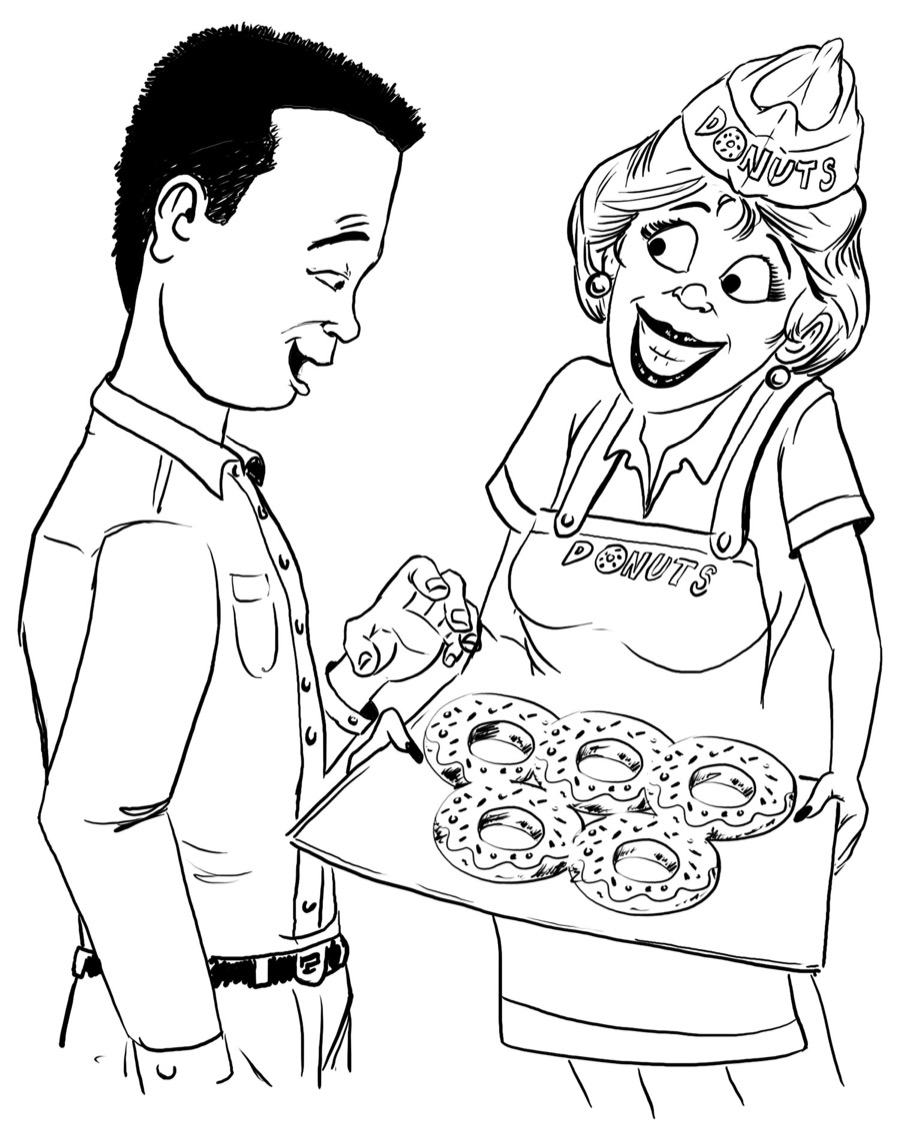
On day 3, Jia walked into Krispy Kreme and asked for five donuts interlinked in the shape of Olympic rings. The woman asked him when he’d like them. The question caught him off-guard. After all, his goal had been to get rejected. Not knowing what else to do, he said he needed them in fifteen minutes. The woman pulled out a piece of paper and drew out the rings to make sure she had the idea right, then said, “Let me see what I can do.”
Fifteen minutes later, a shocked Jia walked out with a box full of donuts arranged like Olympic rings. He hadn’t realized at the time how much getting that surprise “yes” would change his life. He posted the video online, like he had the previous two days. Except this time, it took off like wildfire. Jia’s video of Jackie, the Krispy Kreme lady, making him Olympic ring donuts received millions of views. In a matter of days, he went from being an ordinary guy trying to get through his own fear of rejection, to becoming a celebrity rejection expert. Talk shows called to interview him about his rejection journey. He was pitched on hosting a reality TV show as the Rejection Whisperer. He flew around the country giving talks on rejection.
Before his 100 days of rejection were up, he’d achieved so much success on his rejection journey that he closed his startup to teach about rejection full time.
A few years ago, I learned firsthand the power of putting aside my fear of rejection and asking for more. Over the course of two days, I called all my vendors in my core business, cabinet hardware sales, with a long list of questions and requests. I asked each vendor what margins their best customer received. I expected the vendors to tell me this was proprietary information, but virtually all of them were happy to share their numbers. If they had customers receiving better pricing, I next asked what I’d have to do to get the same margins. Some of them improved my pricing on the spot, just because I’d asked! Others told me they had criteria I had to meet, such as purchasing a minimum number of display boards, placing a large inventory order, or increasing my sales volume.
I asked if I could get better shipping rates. I asked if they’d be willing to cover any of my advertising expenses (known in the industry as co-op advertising).
I’d estimate the calls took no more than six hours total. Most of them didn’t lead to increased margins. But enough of them yielded fruit that I increased profits by thousands of dollars a year. Had I called a decade earlier, my additional profits would have been in the tens, if not hundreds, of thousands of dollars.
At first, I felt like an idiot for waiting so long to make these calls. But the more conversations I had, the more I got the impression my requests were anything but ordinary. When I asked one vendor about co-op advertising money, the response I received was, “No one’s ever asked for that before. Let me ask my manager and I’ll get back to you.” A week later, she replied with a “yes.” I know this brand deals with thousands of customers, yet shockingly, none of them thought to ask.
Most importantly, I didn’t damage a single relationship by reaching out. At worst, I received a polite “no” in response to my requests, but I didn’t lose any vendors or create bad blood.
Remember, failing to ask is asking to fail. If you can move toward rejection rather than shrink from it, it will open a whole new world of options. Take a moment to consider the following questions:
- What steps can you take to build your resilience in the face of rejection? Can you take a page from Jia Jiang and put yourself in positions to face rejection more often rather than less?
- What requests can you make right now that you’ve been avoiding?
- Who’s effort, wisdom, or money could you recruit to move your goals forward?
- Think about the biggest failures you’ve faced. In retrospect, was there someone you could have turned to for help but didn’t?
- The next time you find yourself afraid to make a big ask, pause and reflect on the possible outcomes. How much will you gain if you get a ‘yes’? What will it cost you if you get a ‘no’? You might find the potential gains hugely outweigh the losses.
Nothing in this book will make you immune to rejection, but as we’ll see in the next chapter, there are steps we can take to reduce the impact of being rejected.
