Jordan Harbinger spent 11 years building his podcast audience, his email list, and his social media following. He lost them all overnight. These listeners downloaded his show, The Art of Charm, an average 4.1 million times per month. But a split with his partners at The Art of Charm led Jordan to walk away, and he didn’t do it alone. Most of the production staff exited with him. All of which left Jordan with a gigantic problem: how was he supposed to support a sizable staff, let alone himself, when he had zero subscribers?
Fortunately, Jordan had two things going for him. First, he was no stranger to extricating himself from tight situations. This is a man who’d been kidnapped and escaped. Not once, but twice. Besides having the internal strength to get himself out of tight jams, Jordan had an external asset as well. It’s this second asset that will help us understand the focus of this chapter: the immense cumulative power of frequent, low-stakes actions.
When I think of radio personalities, I picture larger than life, highly extroverted individuals. But when growing up, Jordan hated attention. “Now they call it social anxiety, but then it was just you’re a big weirdo.”
Jordan’s social anxieties drove him to frequently skip school, and even though he made it through college, he graduated without a clear passion or career path. “I did what a lot of guys do when they run out of career options, and I became an attorney.”
Let’s take a moment to discuss how corporate law firms work. Attorneys track their time meticulously to bill for minutes spent working for a specific client. Any time spent on lunch breaks, bathroom visits, chatting with coworkers, networking events, skill development, etc., doesn’t count as billable hours, the single most important metric to the corporate lawyer. Big New York firms expect their attorneys to bill at least 2000 hours per year, and given how much time non-billable activities take, this can lead to an extremely long workweek.
The shy newbie had no problem working late into the night, pouring over legal documents to clock his time. But one aspect of his first few months in corporate law didn’t go so well. All new associates were supposed to have a mentor in the firm, but Jordan’s mentor kept blowing him off. While most attorneys barely saw the light of day, Jordan’s mentor, on the rare occasions he was spotted in the firm, always had a tan. He spent more time traveling and playing golf than poring through case law.
The other associates in the firm were going out to Blue Man Group and the finest restaurants with their mentors, while Jordan’s wouldn’t even speak to him. Finally, HR put enough pressure on the mentor that he agreed to a short meeting at the Starbucks in the lobby. Even then, Jordan didn’t get his mentor’s full attention — he kept checking messages on his Blackberry — but at least he said, “OK, ask me anything you want.”
Jordan asked him, “How come you’re never in the office but you’re a partner and you make a lot of money?”
“Mostly, I generate business for the firm.”
That response made no sense to Jordan. Where were this guy’s billable hours?
The mentor explained he had friends at several big investment banks, and if his friends were out biking, golfing, or playing squash, he joined them because his value to the firm outside the office was greater than his value inside the office. He didn’t worry about missing his billable hour bonus each year because he received commissions on the deals he brought in.
Until then, Jordan knew of two ways to get ahead in law: outworking and outsmarting his peers. His mentor presented a third way, a way that required neither crazy hours nor legal expertise. It was the power of building a strong network and leveraging it. The mentor emphasized the ability to bring in business was hugely valuable, and if Jordan could excel in this area, it could be a strong path to success.
Just what every introvert with social anxiety loves to hear.
I also know a thing or two about a social anxiety blocking a clear pathway to success. As I mentioned in the introduction, the first time Chana and I attempted to build a course around our book The Size of Your Dreams, we discarded the videos we shot in Ecuador, never even reviewing them. In that version, only Chana appeared on camera while I worked behind the scenes. Why? Because I was terrified of being filmed.
Ironically, an unrelated event in that same rainforest forced me to face my fear of the camera. I was taking an online course with Russell Brunson, one of my favorite marketers, when he made a bold claim. “If you publish every day for a year, I promise it will change your life.” Publishing, he explained, could take one of three forms: a blog post, a podcast episode, or a video. He advised playing to strengths. “If you’re a good writer, then blog. If you have a good voice, podcast. If you’re good on camera, video.”
I thought about his claim all day. I’d already published three novels, so I could clearly write. I’d never loved blogging, but with the promise it would change my life, what did I have to lose? I committed to a year of daily blog posts.
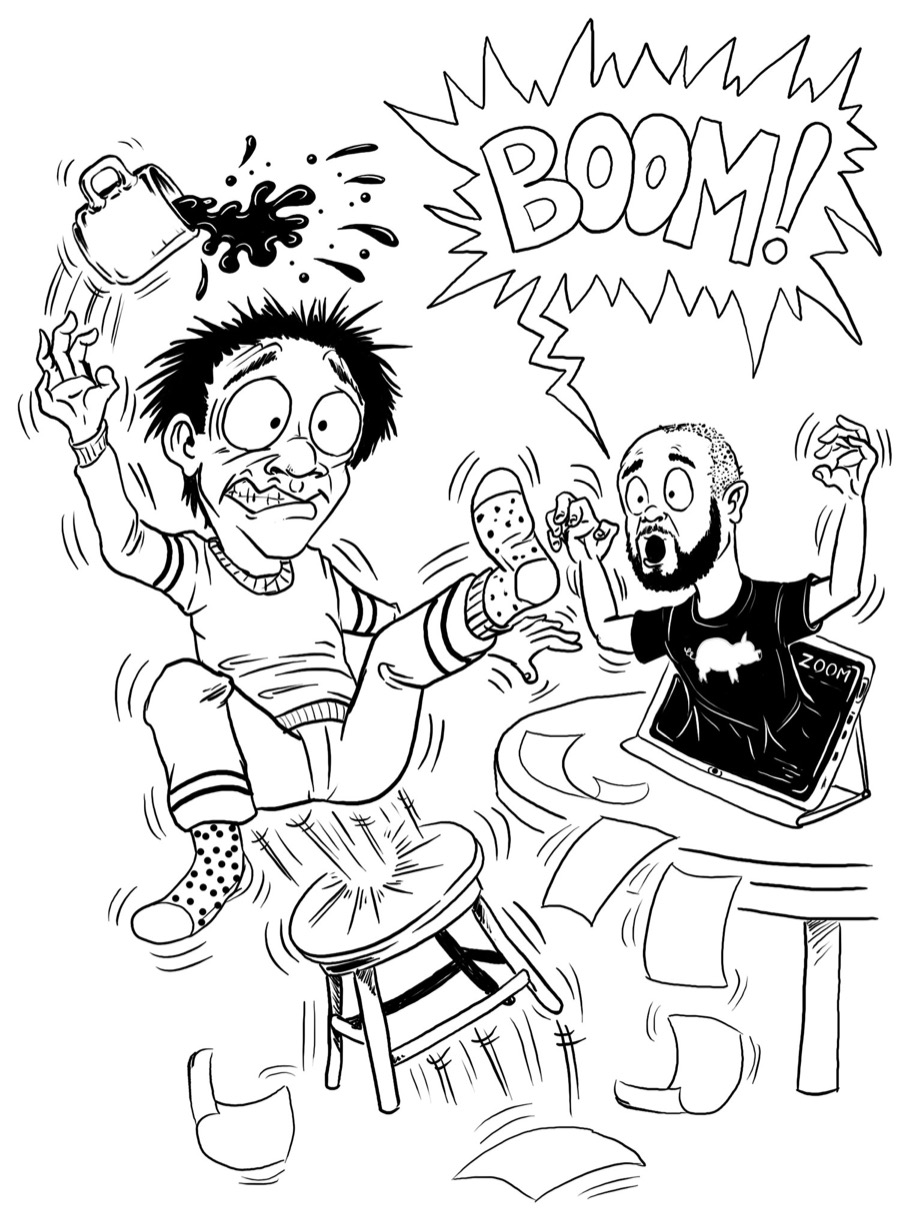
That commitment only lasted a few hours. In the evening, Russel’s right-hand man, Stevie Boom-Boom, did a live session to clarify and reinforce the Russel’s lessons from earlier in the day (Stevie Boom-Boom’s real name is Stephen Larson, though he quickly earned the Boom-Boom nickname in our family for the earsplitting “Boom” he screamed into the mic at the beginning of each class). Boom-Boom agreed everyone in the course absolutely had to start publishing immediately, but he gave slightly different advice than his mentor. Boom-Boom said if we liked reading blog posts we should blog, if we liked listening to podcasts we should podcast, and if we liked watching videos we should make videos.
This may sound like a small difference, but to me it was huge. Whereas Russel advised me to go after my area of greatest skill, Boom-Boom advised me to go after my area of greatest passion. Even though I was a writer, I never had the slightest interest in reading blog posts. But I loved watching videos. Unfortunately, as I mentioned above, I was deathly afraid of the camera. Even at our wedding, I refused to have a videographer because I knew I’d freeze up.
It would have been easy to ignore Boom-Boom’s advice. After all, he was contradicting the counsel of his own mentor, one of the world’s top marketers. But in my gut I knew Boom-Boom was right. If I got on camera every day for a year, if I faced my fear every single day, that would transform my life. I resolved to do it. I would make a daily video.
But I didn’t.
Days passed and no filming took place. My fear of getting on camera loomed too large.
Despite my hesitation to make videos, this 30-day challenge was the best and cheapest marketing course I’d ever taken, so I enrolled again the next time it ran (course details are in the notes section at the end). Since I learn best when teaching, I recruited a dozen friends to take the course with me. Each week we met as a group, and I added whatever insights I’d learned since my first time through. When we got back to the section about publishing every day, I knew I couldn’t encourage my peers to do it if I wasn’t going to follow through myself.
Russell always said it’s no big deal going on camera. When you start out, you’ll most likely only have your mom watching anyway. So on my 45th birthday, I decided to record myself and publicly commit to publishing at least 250 videos by the time I reached 46.
I set up my phone and got ready to record. I stared at the camera. The camera’s electric eye stared back at me. I froze up again. I so needed to get over my fear. The problem was, I always thought I looked ridiculous on camera. And how many thousands of times had I said aloud that I hated being on camera?
As we saw in the section about Sara Blakely and her father, the words we use and the stories we tell have tremendous power. I needed a new story, and I needed it fast, as the day was coming to a close. Fortunately, I knew a thing or two about the dynamics of changing beliefs. I jumped up and down until I got myself into a high energy state and screamed out, “I love the camera! The camera loves me! I love the camera! The camera loves me!”
I kept screaming it until I believed I wouldn’t be a total loser on camera. I hit record, and the first time I stumbled over a word, I felt like a total loser on camera. I jumped again, I screamed again, I hit record again, I stumbled again, I felt like a loser again. Rinse and repeat, rinse and repeat.
I don’t recall how many times I messed up before I finally had a take I was willing to post online, but fortunately my phone didn’t run out of memory. I shared it with trepidation, but of course, all I got back was positive reinforcement and birthday wishes. No one told me I was deluding myself or I had no business posting online videos, even if they were thinking it.
Russell was wrong about one thing. He said only my mom would watch in the beginning, but even she didn’t stick around long (she watched one or two videos and gave up). My videos were awful, and it wasn’t just because I was awkward. I also skipped from topic to topic completely at random. Some days I’d talk about spiritual concepts, other times business tactics. I alienated most of my meager audience within a matter of days, and I’m sure quite a few of my “friends” quickly unfollowed me.
But by this point, I didn’t care. I wasn’t making the videos for “them” anyway. These videos were all for me, and it didn’t take long to see improvements. I improved my posture, body language, and volume. I learned how to edit videos. I created intros. I tweaked my lighting and audio. Little by little, I got better.
Fifteen months later, when we launched the live version of Dream, Design, Manifest, I no longer questioned whether I belonged on camera. Russell promised that publishing every day would change my life, and it did. Hurrying Up and Failing on video helped me transition from a reclusive writer who taught from behind a keyboard to an online teacher able to interact with my audience.
The key to my transformation was lowering the stakes by creating lots of low-risk opportunities to fail. Had I waited to get on camera until an enormous opportunity came along, one so big I couldn’t say no despite my fear of being filmed, I would have risked catastrophic disaster. Instead, I took baby steps each day, hitting my point of discomfort over and over, until I slowly expanded my comfort zone.
The cumulative impact of many small steps can be huge, often much greater than the impact of gigantic efforts made on a less frequent basis. And this was ultimately the key to how an attorney with social anxiety overcame his fear of people and built himself a robust network.
Let’s return to the story of Jordan Harbinger, who just learned that strong networking skills could be an easier and more reliable path to success than slaving at his desk late into the night.
Have you ever noticed that those who struggle most to learn a skill often become the best teachers? When one spends years of deliberate effort mastering something, they develop an understanding of its nuances that a natural might never grasp. Perhaps that’s why Forbes now refers to this former introvert as one of the best relationship builders anywhere.
Jordan speaks five languages, and he’ll tell you the key to learning a language is full immersion. But when it comes to networking, he teaches the opposite. To build strong networks, you don’t need to fully immerse yourself into the world of the socialite. Rather, much like my experience getting over my fear of the camera, you need to take purposeful, simple actions each day. On his website, Jordan offers a free class called 6 Minute Networking, which walks through the steps anyone can take to strengthen their network if they’re willing to dedicate 6 minutes every day.
Why space out your networking over time? Because, as Jordan points out, when you’re already thirsty, it’s too late to dig a well.
What does that mean?
Imagine this scenario. You go into the office one day, and the boss wants to see you. She’s real sorry, she says, but earnings are down and the board decided to make cuts. With no warning, you find yourself unemployed with nothing but a one month severance check to fall back on. So what do you do? You probably start brainstorming who could help. Then perhaps you send out messages saying, “Hey, long time no speak. I hope you’re doing well. I was wondering, perhaps you could help me out…”
One of Jordan’s exercises is to think of the first ten or fifteen people you would contact if you ever found yourself laid off and desperate. If these are the people you’d seek out in a crisis, these relationships are too important to risk fading. You want to reengage those people now while things are good and when you don’t need anything. In fact, while everything is going well for you, see if there’s any help you can give them. Strengthen these relationships before you need them. Dig your wells before you’re thirsty.
When Jordan left The Art of Charm, he lost his email subscribers, his social media followers, and all of his iTunes subscribers, an audience that took him 11 years to build. Having already been the host of a successful podcast, Jordan figured it wouldn’t take him 11 years to rebuild an audience, but still expected it to be a long haul, perhaps even five years, to return to his former number of listeners.
But while he didn’t have subscribers, he still had his personal contacts. For years, he’d been building and nurturing his network of friends. The question was, would they respond now that he needed help? Many of us find it easier to give help than to ask for it in return. Jordan, who struggled for so many years with social anxiety, was nervous about the reaction he’d get now that he was in need. But he made the phone calls, he sent the messages, and then he waited to see results.
This is a book about failure. So did Jordan’s outreach attempts fail?
No doubt many of them did. Whenever anyone engages in an outreach campaign like this one, they can expect a huge failure rate. Had Jordan banked on only one or two individuals exerting themselves on his behalf, he might have found himself at a dead end. However, because he had spent years performing small, daily networking tasks, he built relationships with so many influential individuals that the failures didn’t inhibit his success.
One person he reached out to was Tom Bilyeu, host of Impact Theory. Tom had Jordan on his show to talk about the launch of his new podcast, The Jordan Harbinger Show, and during the episode, Tom described how the two of them first met. “Out of nowhere [Jordan] reaches out to me and says, ‘Hey, I’ve been watching your show. I think it’s fantastic. Let me know how I can help.’ I was like ‘Whoa, Jordan Harbinger just reached out to me, this is crazy.’” This initial outreach occurred when Tom was fairly new to podcasting and Jordan was already a star. Jordan had suggested guests for Tom’s show, and Tom replied they tried to get those exact people but couldn’t land them. Jordan stepped in and made introductions, helping Tom get the high-profile guests he wanted. Tom concluded the story by saying to Jordan, “I have said privately a thousand times…no one outside of this company has had a bigger impact on this company than you.”
Tom was part of a cadre of influencers who rushed to answer Jordan’s call for help. Within three weeks, the brand new Jordan Harbinger Show had over a million downloads. Apple recognized his podcast as the best and most downloaded new show of 2018. Two years later, his monthly downloads topped six million, about 50% higher than The Art of Charm reached at its peak.
When I came out with my fourth book, The Cash Machine: A Tale of Passion, Persistence, and Financial Independence, I knew I needed a different approach to book marketing. All three of my previous books had their loyal fans, but despite strong reviews, none of them broke through to be consistent bestsellers. In many ways, it would have been easier if I received lackluster feedback. But with the two books I’d released the year before, The Key of Rain and The Size of Your Dreams, the feedback and reviews were incredibly positive, which left me frustrated. Why? Because I knew the lack of sales was a direct reflection on my pathetic book marketing, not the quality of my books.
Podcasts struck me as a wonderful medium to spread the word about The Cash Machine. The podcast format gives listeners a chance to delve into the meat of a subject, and I’ve often picked up books myself that I first learned about on podcasts. For years, I’d dreamed about appearing on one of my favorite podcasts like The School of Greatness by Lewis Howes. But as I thought about a promotion plan for The Cash Machine, a realization hit me: I wasn’t ready for the big leagues.
Getting booked on a top podcast is about more than writing a good book. Here I was, this massive introvert who had hardly given any interviews. What would happen if Lewis Howes suddenly called and invited me on his show? I’d stumble over my message, I’d get frazzled by his questions. Of course, all that was merely theoretical, because even if he somehow read and loved my book, I doubt he’d invite me if I hadn’t already proven myself as an articulate, polished guest.
At this point, I had successfully hit my goal of making 250 videos in the space of a year and was no longer afraid of appearing on camera. It was time to turn my attention to developing another skill, the skill of giving a great interview.
As I’d previously done with my videos, I gave myself a simple, measurable goal, to reach out to five podcasters per day, five days a week.
I often sent my outreach emails at night right before I went to bed. Why? In many ways, it’s the worst time of day to reach out because if anyone responded, I wouldn’t be able to follow up until the next morning. The emails went out at night because they were so far outside my comfort zone that I kept pushing them off. But because I’d made a commitment to myself, I had to send them before heading to sleep.
As with the videos, I kept reminding myself that small, deliberate actions taken regularly pay off. And when I started out writing these messages, I didn’t exactly know what I was doing. As evidence of my ineptitude, here is how Doc Green, host of the Earn and Invest podcast, introduced me on his show:
“I have to admit, I was a little bit skeptical of Dave Mason. He wrote me over Facebook and said, ‘Hey, I’ve got this book. I want to be on your podcast to talk about it. It’s called The Cash Machine. I was like ‘yeah, whatever, send me the book, I’ll take a look, and then I’ll consider.’ A week later, the book comes in the mail. It’s a Saturday, I have nothing to do. I sit down for a few minutes to read while I’m in between things. Four hours later I look up and I’m done.”
As Doc’s intro implies, my first outreach emails were sorely lacking, but as with my videos, they gradually got better. And podcasters know podcasters, so as I did interviews, I’d ask the hosts for introductions to other podcasters. My interview with Doc Green, for instance, helped me get on Joe Saul-Sehy’s Stacking Benjamins show, which Kiplinger had rated as the top finance podcast. And later, when I ran my own financial summit, both these hosts became my guests.
Gigantic failures sting. If all your hopes come down to one final Hail Mary pass, to one winner takes all bet, to one pitch that will either make or break your business, then you risk disaster.
Far better to engineer many small failures than risk a big one. The vast majority of my podcaster outreach emails were failures. Less than half of those I contacted even responded, and less than half of those who wrote back expressed interest. Each one of those emails that didn’t yield an interview was a failure, but it was a small failure, one that barely stung at all, and that was ultimately overshadowed by successes.
Instead of sending out five pitches a day, I could have spent months preparing the perfect pitch to one of the world’s top podcasters and based my entire strategy on landing that one show. In that scenario, I wouldn’t have received daily feedback on my pitch emails, I wouldn’t have practiced my interview skills day after day, I wouldn’t have honed my process or built my network. My odds of failing in that one epic pitch would have been tremendous and the impact debilitating.
If you want to get started engineering these small failures, the following strategies can help:
- Define your commitment. What is it you’re willing to do? Publish a video each day? Network with 10 people a day? Your commitment needs to be measurable such that you’ll know each day if you accomplished it or not.
- Avoid perfectionism. Especially in your early efforts, just getting it done can be an accomplishment. Don’t set the bar so high that it blocks you from taking daily action.
- Establish consistent routines. Do you take action first thing in the morning? Last thing at night? Consistency helps your actions stick and develop into a habit.
- Pair the new habit with an existing one. If you love your morning smoothie, you can drink it while sending your outreach emails. Or you can use that same smoothie as a reward for recording your daily video. Either way, the engrained habit can help you embed the new one.
- Keep upping your game. When I first started making daily videos, just recording them was a victory. Later victories came from improving my sound, lighting, and my process for creating content. Remember, this is a process for growth and you want your results to continually improve.
In Part 1, we discussed the need to embrace failure. Fear of failure makes us play it safe, and very little learning and growth occurs in our safety zone. The more we delight in our failures, the more we can stretch ourselves and get into that arena where learning and growth prosper.
In Part 2, we saw that we can engineer failure to derive maximum benefit. Once you’ve entered the Death Zone on Mount Everest, the stakes of failing are far too high. We get the most benefit from our failures when they occur rapidly and with little risk.
Of course, the point of engineering failure is to learn from it. Failure alone doesn’t guarantee improvement. Even worse, we can walk away having learning the wrong lessons. That’s why in Part 3 we’re going to explore how to most effectively learn from our failures.
