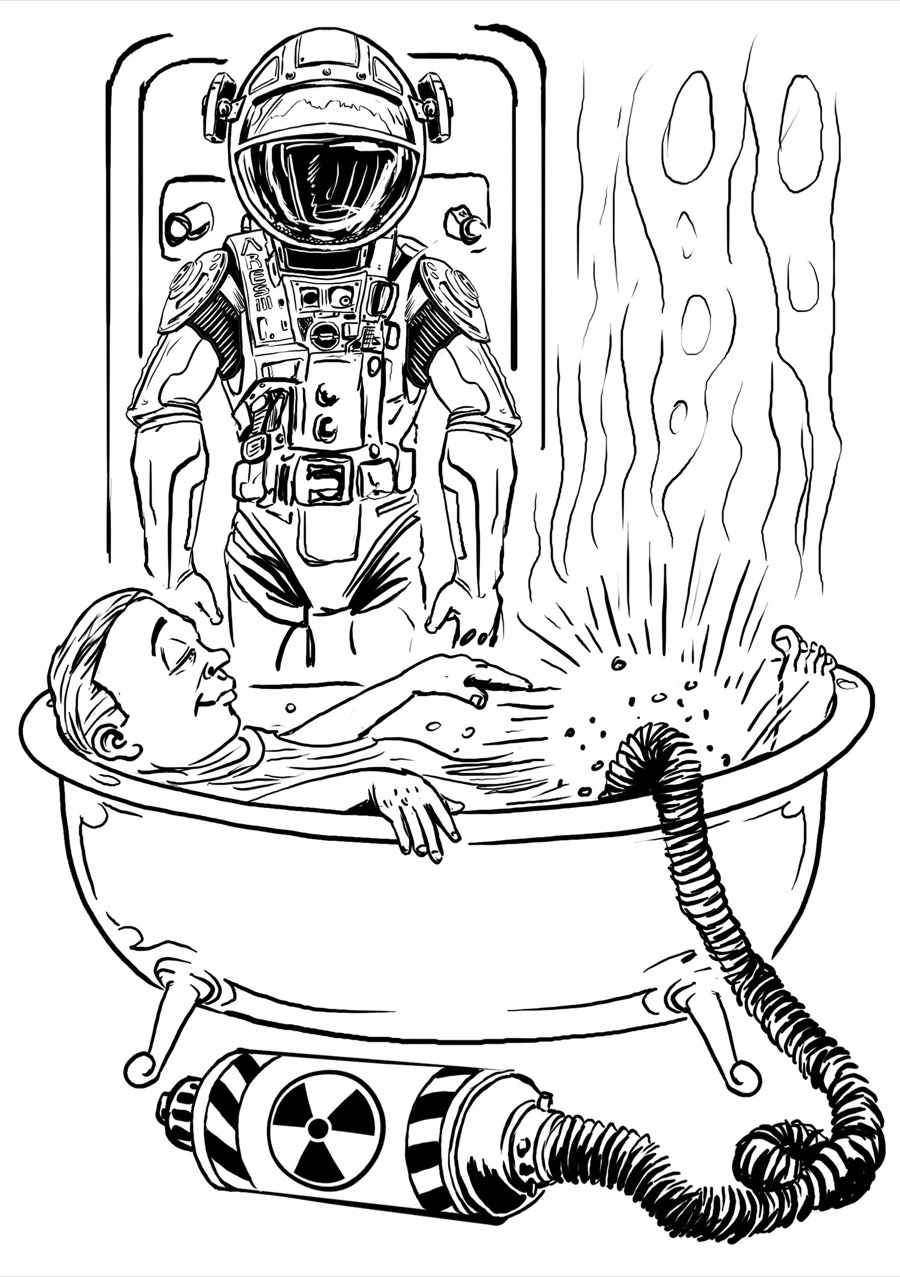
Mark Watney desperately needs heat. Actually, as an American astronaut left for dead on Mars, what he desperately needs is a radio capable of communicating with Earth. And he knows where to find one. In 1996, NASA had launched the Carl Sagan Memorial Station, better known as Pathfinder, to explore the surface of Mars. NASA had long since lost contact with the antiquated Martian probe, but if Watney can find the probe and get it working again, he could send a distress signal to Earth and let NASA know he’s still alive. He has enough solar cells to power his Mars Rover for the drive to Pathfinder. It wouldn’t be fast. Most of the day would be spent recharging the batteries just to fuel a couple of hours of driving. But he could do it. His problem is keeping warm in the frigid Martian atmosphere, which would require more than half the Rover’s battery power and undermine his ability to make the drive in time. He has a solution, but the risks are terrifying.
For anyone not familiar, this scenario is taken from the seventh chapter of Andy Weir’s brilliant book, The Martian, later made into a movie starring Matt Damon. Before reading The Martian, I’d thought of science fiction as fictional science. Star Wars and Star Trek adhere to scientific laws only when convenient. As one comic put it, “Science fiction that follows the law of relativity is relatively boring.” But The Martian is different. I think of it as MacGyver in space, and Andy’s adherence to the constraints of science and technology make the book both thrilling and educational.
Back to Watney’s need for heat. His solution? Using the RTG. What’s an RTG? I’ll let Watney explain in his own words:
‘The RTG (radioisotope thermoelectric generator) is a big box of plutonium. But not the kind used in nuclear bombs. No, no. This plutonium is way more dangerous!
Plutonium-238 is an incredibly unstable isotope. It’s so radioactive that it will get red hot all by itself. As you can imagine, a material that can literally fry an egg with radiation is kind of dangerous.
…As long ago as the 1960s, NASA began using RTGs to power unmanned probes… But they never used RTGs on manned missions until the Ares Program.
Why not? It should be pretty obvious why not! They didn’t want to put astronauts next to a glowing hot ball of radioactive death!
In The Martian, the RTG is only intended to power activities on Mars until the astronauts arrive. As soon as they land, one of the first things they do is bury the RTG four kilometers away from their base, where it could cause them no harm.
One thing Andy Weir does exceptionally well in The Martian is to connect readers to Mark Watney’s emotional rollercoaster. Being stranded for years on an unfriendly planet while living in quarters only intended to support human life for 30 days puts him in constant risk of death. And he doesn’t just need to survive, he has to constantly solve problems, including how to communicate with Earth, feed himself, and get off the planet.
The RTG can provide Watney with more than enough heat to keep warm during his trip, but Watney is freaked out by the prospect of using it. He’d almost died once while making water from rocket fuel, and he’s convinced using the RTG will “be far more dangerous.”
The book is a nail-biter. It’s funny, thrilling, and clever. But I have to admit, if there was one segment where I didn’t feel emotional resonance with Mark Watney, it was this segment with the RTG. Somehow, I couldn’t feel his fear with the “glowing hot ball of radioactive death” that would make NASA engineers “hide under their desks and cuddle with their slide rules for comfort.” It was only during an email correspondence with Andy Weir during the writing of this book that I finally understood why this one segment failed to resonate, and I came away with even greater respect for Andy’s integrity as a writer.
Few movie companies have enjoyed as much success right out of the gates as did Pixar, the digital animation studio purchased by Steve Jobs in 1986, soon after Apple gave him the boot. Their initial release, Toy Story, was the first ever feature film created exclusively with digital animation and became the second highest grossing film of 1995. Pixar followed that with hit movies A Bug’s Life, Toy Story 2, and Monster’s Inc. Disney had an exclusive contract to distribute Pixar films, and enjoyed huge profits from Pixar’s early success. When the contract between Disney and Pixar drew near its close, there was no question Disney wanted to renew their arrangement with the groundbreaking animation company.
But there was still a question of timing. If Disney negotiated the new contract on the heels of a hit film, they’d pay a lot more than if the negotiation followed a flop. No movie studio produces only hits without its periodic failures. Surely Pixar, which had four hits in a row, would be due a failure soon, right?
That’s what the board at Disney wanted to know. If the next movie was going to be a hit, they were better off signing a deal before its release. But if it were a dud, they’d save millions by waiting until after its release. Fortunately, they had the perfect way to find out. Michael Eisner, the iconic Disney Chairman and CEO, was going to visit Pixar and would check their latest film’s progress.
Afterwards, Eisner emailed the Disney board reporting the following:
Yesterday we saw for the second time the new Pixar movie ‘Finding Nemo’ that comes out next May. This will be a reality check for those guys. It’s okay, but nowhere near as good as their previous films. Of course, they think it is great.
The board, trusting in Eisner’s ability to assess the caliber of an animated feature, took his advice to wait. Huge mistake. Finding Nemo won the Oscar for Best Animated Feature and became the highest grossing animated film of all time.
How had Eisner gotten it so wrong?
In the Steve Jobs biography by Walter Isaacson, this story is used to illustrate how Eisner had grown out of touch with audiences. Certainly, if he could so thoroughly miscalculate the success of the highest grossing animated movie of all time, then he had no business being the head of Disney, a company built on its domination of the animated movie market.
But not so fast. Is it possible Eisner’s judgment wasn’t so poor? Remember, Eisner didn’t see the version of Finding Nemo that rocked the box office. He saw a draft. And Eisner wasn’t known for his intimacy with the Pixar team. As Jobs recounts:
During the twenty-year relationship, he visited Pixar for a total of about two and a half hours, only to give congratulatory speeches. He was never curious. I was amazed. Curiosity is very important.
Had he been curious, he would have learned that Pixar operated differently from the animation department at Disney. “Early on, all our movies suck,” Pixar cofounder Ed Catmull writes in his book Creativity, Inc. “We are true believers in the power of bracing, candid feedback, and the iterative process—reworking, reworking, and reworking again, until a flawed story finds its through-line or a hollow character finds its soul.”
Two of Pixar’s strongest tools for this feedback are the BrainTrust and Dailies. The BrainTrust brings together Pixar’s heavy hitters to review the progress of a movie in development every few months. As Pixar director and BrainTrust member Andrew Stanton likes to say, “If Pixar is a hospital and the movies are the patients, then the Braintrust is made up of trusted doctors.” Bob Peterson, another member of the Braintrust, compares it to “The grand eye of Sauron.” But Catmull is quick to point out that unlike Sauron, “The Braintrust is benevolent. It wants to help. And it has no selfish agenda.”
Catmull calls early versions of their stories ugly babies. “They are not beautiful, miniature versions of the adults they will grow up to be. They are truly ugly: awkward and unformed, vulnerable and incomplete. They need nurturing—in the form of time and patience—in order to grow.” Catmull says the Braintrust is crucial to this process. “The BrainTrust is where we figure out why they suck, and it’s also where they start to not suck.”
The BrainTrust is a blunt instrument. Within its sphere, entire storylines drop away. But at Pixar, they don’t just have feedback sessions every few months when the BrainTrust convenes. Each day, teams at Pixar get together to critique everything developed the day before. “The Dailies keep everyone in top form,” Director Mark Andrews says. “It’s an intimidating room to be in because the goal is to create the best animation possible. We go through every single frame with a fine-toothed comb, over and over and over again.”
For example, take the following sequence from the movie Brave, in which one of the main characters transforms into a bear. In the Dailies, Andrews was bothered by a ten frame sequence of the bear walking. “She looks like she’s stepping more catlike than heavy-bear-like,” he said. “I like the overall speed, but I’m not feeling the weight. She’s walking like a ninja.”
For context, ten frames in a movie is less than half a second long. Is your experience of a movie going to change all that much based on how a bear is walking during that fraction of a second? Most studios probably wouldn’t bother analyzing it, let alone fixing it. But at Pixar, where getting each detail right is an obsession, the animators went back to adjust the bear’s gait.
Which brings us back to Finding Nemo, the movie Eisner thought would be Pixar’s first disaster. The Pixar team had just gone through an excruciating process with Toy Story 2, a movie originally slated as a low budget direct-to-video film that Pixar completely remade for theatrical release. Their now famous feedback mechanisms, the BrainTrust and Dailies, had yet to be perfected. Indeed, at the time, rather than seeking more feedback, they desired a process with less. The eleventh hour changes in Toy Story 2 were so stressful, they wanted to get the story right the first time and dispense with the need for major edits later on.
As Catmull recounts, “Looking back, I realize we weren’t just trying to be more efficient. We were hoping to avoid the messy (and at times uncomfortable) part of the creative process.” The creative process can be messy. Getting honest feedback can be uncomfortable. But Nemo just wasn’t coming together. A series of flashbacks, which had sounded great during the pitch stage, didn’t have the desired effect in early versions of the movie, coming across, as one BrainTrust member called them, as “cryptic and impressionistic.” The main character, Marlin, initially felt unsympathetic and unlikeable, but when flashbacks were replaced by a more linear script, one that showed from the beginning why Marlin was so terrified of losing his son to the dangers of the ocean, the story flowed better and Marlin became more appealing.
As much as the Pixar team wanted to get Finding Nemo right the first time, they realized such expectations weren’t realistic if they wanted to produce their best work. If creating great films was the goal, they needed to be open to feedback and be willing to make the changes when necessary, both on the large scale (through the BrainTrust) and the small scale (through Dailies).
Andy Weir, author of The Martian, describes himself as a lifelong space nerd whose hobbies include relativistic physics, orbital mechanics, and the history of manned spaceflight. With a biography like that, you might expect Andy’s career path to include astronaut or mechanical engineer at NASA. But, perhaps due to his fear of flying, he never worked in the space sector, instead becoming a programmer for AOL, Palm, and others. Still, he never stopped devoting his free time to his love of space.
Like all authors, I’m sure Andy dreamt of his novel taking off and becoming a massive hit. But in the initial stages, authors can be extremely secretive about their books. I worked on my first book for years before anyone other than my wife even knew I was trying my hand as a writer. Most authors reveal their work carefully, perhaps only showing early drafts to a trusted loved one for feedback, as I did with my wife, Chana. Slowly, the inner circle expands. The next reader might be an editor. Agents and publishers have to wait for another draft or two before getting a glimpse. Reviewers come in late in the game, when the book is in near publishable form. Finally, after much fanfare and a well-anticipated launch, the public finally gets their hands on it.
But Andy didn’t write this way. When he completed each chapter, he posted it for free on his personal website. As he told me, “I had about 3,000 regular readers at the time, most of them hardcore nerds. When I got something wrong on science, I’d get a bunch of emails telling me about it.”
Personally, I cringe at the idea of putting any of my early stage writing out for public consumption. But Andy was writing a book that delved into extremely complex science. He wasn’t just dealing with run-of-the-mill astrophysics. He delved into obscure questions like how botany functions on Mars. For one person to understand every complexity is no simple feat. And if Andy erred in obscure areas of science, ordinary editors would never catch them. But a community of 3000 hardcore nerds is an entirely different story.
I asked Andy for examples where audience feedback forced a change to his story. Lo and behold, he came back with our old friend, the RTG. “A nuclear engineer on a US Navy submarine told me about radiation. The RTG, which generates heat, does so via radiation. I had a lot of stuff in there about the dangers of what would happen if the RTG broke open. Turns out that was all wrong. The Navy guy told me RTGs are full of small radioactive beads surrounded by lead. So even if the RTG did break open, Mark would be safe.”
When I read this email, I finally understood why the RTG segment didn’t unnerve me the way Mark’s other near-death challenges did. In the original draft, no doubt the presence of the RTG makes Mark feel he’s always a hairsbreadth away from death. But because Andy had this nuclear engineer among his early readers, he learned his assumptions were wrong. Andy had a choice to make. He could keep the scene in its original nail-biting form. After all, it’s hardly necessary to explain every safety measure when writing a novel. Or he could undermine the drama in the name of accuracy.
I faced a similar situation with my personal finance novel, The Cash Machine, except, unlike Andy, I didn’t learn about my mistake until after publication. The error involved a minor nuance in an obscure law dealing with tax breaks for Americans who live and work abroad. The misquoted segment likely would have impacted exactly 0% of my readers. But it was wrong, and that irked me. I wound up putting out a new edition of the book with the corrected text to get it right.
Had Andy decided the plutonium pellets in his RTG weren’t coated with protective lead, virtually no one would have noticed. Or he could’ve neglected to explain how the lead coating protects the radioactive pellets so readers would still experience a heightened sense of tension, even if the fictional Watney isn’t in as much danger as we think. But my gut tells me being even slightly off on the science bothered Andy the same way being slightly off on the tax code irked me. So he changed the passage, opting for accuracy over emotion.
Stop a moment and think about this RTG mistake. If it hadn’t been corrected in draft form, how likely is it this error would have been identified and corrected at all? Certainly no mortal editor would have caught it. Perhaps if Andy had hired a scientific fact checker to go over each and every detail, it could have been unearthed, but there’s so much science in the novel and the construction of the RTG is so obscure, even then it likely would have passed by unnoticed.
Most likely, Andy would have published The Martian with the RTG mistake intact. Perhaps then, someone like the nuclear submarine engineer would have pointed out the mistake, but perhaps not. I periodically uncover mistakes in books, but I don’t write to authors to tell them because by the time I’ve caught the error, they’ve already moved on to their next project. Andy didn’t just release The Martian early to 3000 nerds, he did so in a way that encouraged dialog and feedback. This is extremely rare. Fixing an error when it’s at the blog post phase is easy. Fixing a published bestseller is difficult. The ability to tap into such a knowledgeable community early on became a huge asset for Andy Weir to make his book so accurate and authentic.
Feedback can truly be a gift. It’s easy to fall in love with the dream of being the genius who works behind locked doors, who emerges and awes the world with the perfect creation. But that’s rarely a recipe for creating greatness. When we open ourselves up to feedback, we get many minds working instead of one, and our early failures can become our greatest successes.
In Pixar’s case, they built two powerful feedback mechanisms into their creative process. The BrainTrust brought together the heavy hitters in the company every few months to review each project. This is where entire story lines would be slashed and otherwise promising films sent back to the drawing board. But they didn’t just have a macro feedback loop that examined their projects once every few months. They also had the Dailies, a micro feedback loop that examined the prior day’s work and made minor changes along the way.
Pixar could build these feedback loops because they’re a large organization filled with obsessive creatives. But as we saw from Andy Weir, even an individual working alone can find effective ways to get feedback, even in the early stages of a project.
If you’re looking to build a robust feedback process, the following tips can help:
- Everyone is an expert on what they like and dislike, but don’t expect everyone to articulate why. I discovered this with the early drafts of my first novel. Readers would tell me when they thought a scene wasn’t working and offer advice for improvement. These readers were always right about which scenes just didn’t work, but most of the time their suggestions for how to improve it only made the issue worse. I needed a seasoned editor to tell me how to make the improvements.
- Ask specific questions. The feedback providers may give more valuable insights if they know exactly what questions you want answered.
- Create a safe space. If you get defensive with each criticism, you may stop getting honest feedback. Allowing feedback to be given anonymously can also help.
- Act on the feedback and follow up. If those giving feedback see that you’re implementing their advice and updating them on the process, they’re more likely to see their efforts as valuable and want to continue helping.
Just like we saw in Part 2 that failures provide the most opportunity for learning when they happen quickly and with little downside, so too with feedback it can be most impactful when received early on and in small doses.
If you’re currently working on a project, ask yourself how you can create shorter, more effective feedback loops. Ideally, you want to be receiving feedback on your work as early as possible. Unfortunately, as we’ll see in the next chapter, most feedback loops are not built this way and may only kick in after catastrophic disaster.
