A few years ago, our family attempted to explore the Ramon Crater in southern Israel. This natural formation is one of the largest craters in the world, formed by millions of years of erosion. Not only does it offer extensive hiking, but the crater is renowned for fantastic stargazing. Unfortunately, our timing was horrible for both hiking and stargazing. Rain is rare in the Negev desert, but we arrived right in the middle of a storm, and visibility was so poor that even from the shelter of the visitor’s center, we couldn’t see into the famous crater only a few feet away.
With hiking out of the question, we explored the visitor’s center’s indoor options, which included exhibits on the history, geology, flora, and fauna of the Ramon Crater. But then we saw another exhibit we weren’t expecting: a memorial museum dedicated to an entirely different Ramon, Ilan Ramon, the most famous pilot in Israeli history.
Born Ilan Wolferman on June 20, 1954, just six years after Israel achieved independence, Ilan’s personal history closely models that of the young country into which he was born. His father, Eliezer, escaped Nazi Germany in 1935. His mother, originally Polish, survived the Auschwitz concentration camp before making it to Israel in 1949. When Ilan joined the Israeli Air Force, he exchanged his European last name for a more Israeli one, Ramon.
Ilan fought in two of Israel’s wars, the Yom Kippur War in 1973 and the Lebanon War in 1982, but his most impactful mission for the Israeli Air Force wasn’t flown during wartime. In fact, it was flown against the protests of many of the country’s top military and political figures who considered it a foolhardy move with potentially catastrophic consequences.
On June 7, 1981, Ilan Ramon and seven other pilots took off from Sinai’s Etzion Airbase in heavily armed F-16s. Since midair refueling would be impossible, each plane was equipped with an external fuel tank so they’d have enough gas to return to Israel. But even with the extra fuel, it was considered a longshot that the pilots would make it back alive.
A near-critical mistake occurred soon after takeoff when the jets flew over the yacht of Jordan’s King Hussein while passing the Red Sea. King Hussein identified the Israeli planes and astutely guessed their target. But Ramon and company experienced their first bit of luck when the King’s warning to his allies never got through. The Israeli pilots conversed with one another in Arabic, pretending to be Saudi while flying over Jordan and Jordanian while flying over Saudi Arabia.
The Israelis knew Iraq was confident no attack would ever come from Saudi Arabia and thus had a blind spot on their radar along their Saudi border. So the team flew right through it. As they approached their target, Osirak nuclear reactor, the Israelis experienced their second piece of luck. A half-hour before arrival, the Iraqi soldiers manning the reactor’s anti-aircraft defense left their post for an afternoon meal and turned off their radar. At least eight Israeli bombs struck the reactor, which at the time contained 13 kilograms of uranium enriched to 93%, nearly enough to create a nuclear bomb.
International criticism was fierce in the wake of the Osirak bombing, but Israel’s actions were viewed in a new light a decade later, after the Iraqi invasion of Kuwait. One can only speculate how history would have played out if Saddam Hussein had succeeded in creating his nuclear arsenal.
But Ilan Ramon’s international fame came on an entirely different stage. Twenty-two years later, on January 16, 2003, Ramon took off on his most famous flight. This time, his ship carried no weapons and fought no enemy. The purpose of this flight was to build international cooperation and conduct research that could benefit the entire world. During the 16-day mission, the crew conducted over 75 scientific experiments. But the Ilan Ramon memorial at the Ramon Crater wasn’t built to honor the scientific advancements made during the flight. It exists because neither Ilan Ramon nor any of his six crew mates ever returned alive.
For years, I struggled to understand the concept of escape velocity, the speed needed for objects to enter orbit, approximately 7.9 kilometers per second, over 20 times the speed of sound. This is so fast that orbiting objects like the International Space Station rotate the Earth approximately once every 90 minutes.
In retrospect, my failure to grasp escape velocity probably originated with all the footage I’d seen of astronauts floating in space. I’d become so used to the concept that space was a zero-gravity environment that I couldn’t understand why rockets had to travel so fast once they’d already reached space. Since there was no gravity pulling against them, why couldn’t they simply use less power and orbit at a slower speed?
I should have known better from personal experience. I grew up along the water and saw from an early age that the most extreme tides coincided with full or new moons. Later, I learned every tide was caused by the impact of the moon’s gravitational force on our oceans. So if the moon, which is almost 240,000 miles away and has only about 1.2 percent of Earth’s mass, still exerts enough gravitational force to create the tides, then how can astronauts in orbit, who rarely go beyond 300 miles from Earth’s surface, possibly escape its gravity?
The answer, of course, is they can’t. Astronauts in orbit only escape about 10% of Earth’s gravity. So if they still feel 90% of the gravitational pull, why aren’t they pulled right back down? The answer is speed. Once an object hits escape velocity, gravity can’t pull it down to Earth before it’s moved far enough sideways that it misses the planet. The combination of the downward pull of gravity and the sideways speed of escape velocity instead causes objects to spin around the planet in an orbit.
The challenge with taking a spacecraft to escape velocity is that to return it to Earth in one piece, you need to slow it back down. Space is essentially frictionless, so orbiting objects can move without creating heat or using significant energy to maintain speed. But reentry is a different story. As soon as an orbiting object hits the atmosphere, it meets massive resistance. This is effective at slowing the object, but it also generates tremendous heat.
Satellites can’t withstand the strains of reentry and most simply burn up in the atmosphere. But when sending humans into space, we can’t allow them to combust on reentry. To ensure a safe return, all human-bearing spaceships since the dawn of the space age have been equipped with heat shields.
On January 16, 2003, the space shuttle Columbia launched into space for the 28th and last time, carrying Ilan Ramon and six other astronauts. 82 seconds after liftoff, a piece of foam fell off an external fuel tank attached to the shuttle. Foam might not sound like a highly dangerous object, but it’s estimated the foam struck the left wing of the space shuttle at approximately 500 miles per hour.
To be fair, at the time of the launch, no one realized a two-foot-long chunk of foam struck the Columbia. But NASA had excellent early warning systems in place. Just one day later, a team reviewed the footage in super slow motion and discovered the foam strike. NASA’s Debris Assessment Team mathematically modeled the collision to see if it was severe enough to cause a problem, but their review was inconclusive.
If you were NASA at this point, what would you do? You know a two-foot-chunk of foam struck a heat-resistant tile on the wing at approximately 500 miles per hour, but you don’t know whether or not it caused damage. What would be your next step?
If it were me, the first thing I’d want to know is whether any of the highly sensitive, heat-resistant tiles were damaged during the foam strike. It turns out NASA had two ways to assess whether Columbia sustained significant damage. An astronaut could have performed a spacewalk to investigate the wing, or images of the wing could have been taken by a nearby satellite. At least three requests were submitted within NASA to have such images taken. The requests were denied on the grounds that they were unnecessary and thus a waste of time. A full week passed before the crew was even informed of the problem, but even then it was only to prepare them to answer questions for the media, not for damage assessment.
I’m sure you know by now how the story ends. No assessment was ever done. The foam strike apparently broke a heat-resistant tile, causing a hole in the shuttle’s only defense against the 3000-degree Fahrenheit temperatures (1650° Celsius) that built up in front of the reentering shuttle. That oversight caused Columbia to break apart 40 miles above land. Searchers later recovered over 84,000 pieces of debris spread across Texas and southern Louisiana.
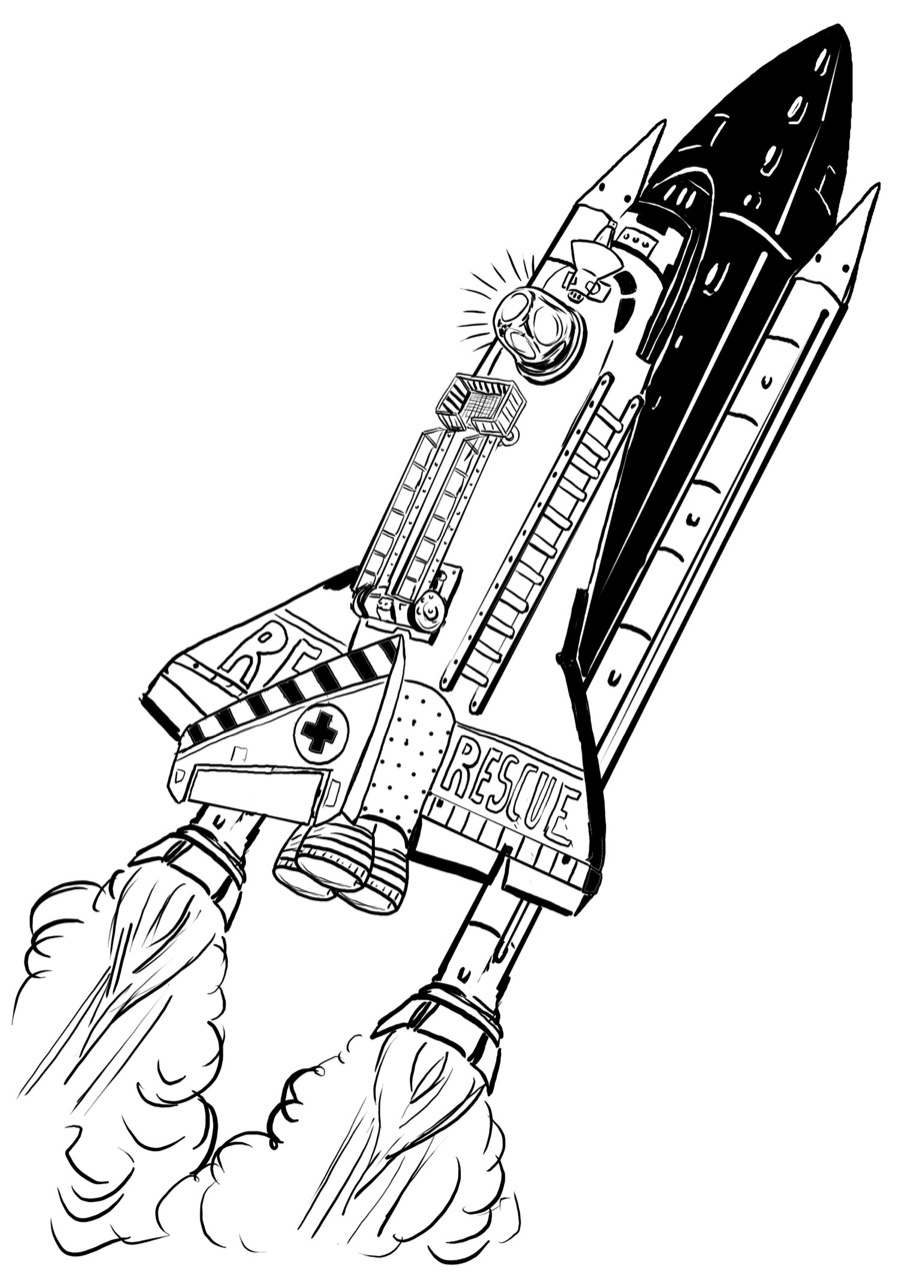
But even if the damaged heat tile had been discovered prior to reentry, could anything have been done to avert the disaster? Repairing the heat-resistant tile was out of the question. The investigation board concluded there was no way the Columbia crew could have repaired the broken tile in space. However, there was another option: a space rescue.
The astronauts on Columbia were relatively safe while they remained in space, at least for a short time. The biggest concern of an extended mission would not have been running out of oxygen, food, or water. It would have been the buildup of carbon dioxide. Humans exhale carbon dioxide with each breath, and if carbon dioxide levels get too high, breathing can be fatal.
The unavoidable carbon dioxide buildup gave NASA a rescue window before Columbia’s air quality became fatal. The question was, did they have a large enough time to get another shuttle into space to perform the rescue before the astronauts died?
Had they discovered the damage and attempted the rescue, NASA would have found their timing extraordinarily lucky. From 1999 through 2002, NASA conducted 19 shuttle launches, averaging just over one launch every two months. But the shuttle Atlantis was scheduled to launch on March 1, 2003, just four weeks after Columbia was due to return.
A shuttle launch is a long process, involving literally millions of steps. To get Atlantis into space in time to rescue the Columbia astronauts, two things would have had to happen.
First, NASA would have needed to put the Atlantis launch process into overdrive, scrapping any non-essential steps to get the shuttle into orbit as fast as possible. Meanwhile, they would place Columbia into low power mode so life support systems could function longer. Like the shuttle itself, the astronauts would also minimize all motion and activity to slow their breathing, and thus their creation of carbon dioxide.
Earlier in the book, we talked about Andy Weir’s extraordinary novel The Martian, which featured NASA’s attempt to rescue an astronaut stranded on Mars. One element the book emphasizes repeatedly is how much effort humanity will expend to save even a single life.
To create public policy, there are models that estimate the value of a human life. Want to raise the speed limit in a certain area? We’ll weigh the increased efficiency against the number of additional deaths we estimate will result from car accidents. The same principle applies to environmental regulations. Strengthen air pollution regulations and fewer people will die from respiratory conditions, but compliance will cause businesses to lose profits. So how much is a human life worth? According to these models, approximately $10 million.
In The Martian, the total cost of bringing Mark Watney home alive probably totaled billions of dollars. But that cost didn’t come across as unrealistic in the novel, because the $10 million figure is only for a statistical life. Statistical lives are nameless and faceless. But that number goes out the window when a specific human life is at risk. When a single child is trapped down a well, people mobilize from around the world to help with the rescue.
In 1970, when Apollo 13 suffered a critical failure that put the lives of its crew in jeopardy, the entire world watched on the edge of their seats. Despite the tensions of the Cold War, the Soviet Union sent four ships to the landing area to help with the rescue. The Pope led a congregation of 10,000 in prayer for the astronauts’ safe return, and 100,000 prayed in a festival in India. The US Senate passed a resolution urging businesses across the country to pause for a unified prayer. Seventy million Americans watched at least part of the telecast when the capsule finally returned to Earth.
From the time the crisis occurred on Apollo 13 until the eventual splashdown, four days elapsed. With Columbia, had NASA discovered the wing damage within a couple of days and sent the Atlantis for a rescue mission, they probably would have needed over a month to save the Columbia astronauts.
Would such a rescue have been expensive? Unbelievably. Tens of thousands of people would have had to gather to create the plans, make modifications to the Atlantis, and get it ready to fly. But no one would have batted an eye at the costs because the lives saved wouldn’t just be statistical lives. One of the lives would have been Ilan Ramon’s, a man born to Holocaust survivors, who helped defend his fledgeling young country in two wars, who blew up a nuclear reactor that could have empowered Saddam Hussein with a nuclear arsenal, potentially throwing the world into its first nuclear war. And that’s just the story of one Columbia astronaut. The other six had stories of their own and loved ones to plead for their rescue. For a full month, the eyes of the world would have focused on the most extensive rescue mission of all time.
It could have been NASA’s greatest moment.
Instead, it was a black mark against the space agency from which they literally never recovered. The Atlantis flight never flew. Two and a half years passed before a shuttle returned to space, and by then, the days of the shuttle program were numbered. The last launch occurred on July 8, 2011.
The ISS continued to function even without space shuttles transporting astronauts and supplies. Those functions were taken over by Russian Soyuz spacecraft. The United States, for so many decades the leader in space travel, took a backseat. The next time astronauts would blast off from US soil would be in 2020, but at that point, it wouldn’t even be NASA taking them to space. The country wouldn’t take back its edge in space exploration through its iconic space agency, but through private enterprise, with NASA contracting out to Elon Musk’s SpaceX.
It’s easy to blame NASA in hindsight for not taking greater steps to prevent the Columbia disaster. It’s important to remember the analysis was anything but straightforward and none of us like to face the prospect of failure.
Early warning systems are a fabulous tool for pivoting quickly when failure looms ahead, but only when you’re willing and able to adjust course based on their feedback. In the last chapter, we looked at how to build effective early warning systems. But it’s not enough to get the warning if the early notice doesn’t directly translate into changed action.
Here are a few pointers on how to make sure that your early warnings lead to effective action:
- Limit warnings to only true threats. One of the biggest problem with early warning systems is that they can sometimes give off too many warnings. If your early warning system is too sensitive it might sound the alarm all the time for relatively minor issues. If that’s the case, your team might already be trained to ignore the alarm when a true emergency comes.
- Assign responsibility. Making sure it’s clear to everyone who is responsible for responding to each type of warning.
- Limit Bureaucracy. If there’s an entire chain of command one needs to go through in order to act on the warning, the chances of an effective response plummet.
- Build emotional fortitude. This is probably the hardest one on the list, but the truth is, sometimes when a warning goes off we’d rather not acknowledge it. The warning may indicate a failure, and in some organizations there might be a temptation to sweep the failure under the rug rather than bring it to light and deal with it. The more you can embrace failure, the easier it will be to take appropriate action when a warning is triggered.
Most of us have aspects of our lives or business we know aren’t working, but we haven’t wanted to face up to the problems and make the changes. We might have warning bells going off all around us, but we choose to ignore them. Take a moment and think about those areas where you’re accepting less than the best. Write them down. Acknowledge them. And then ask yourself, if you weren’t afraid of facing this area, what changes would you make?
