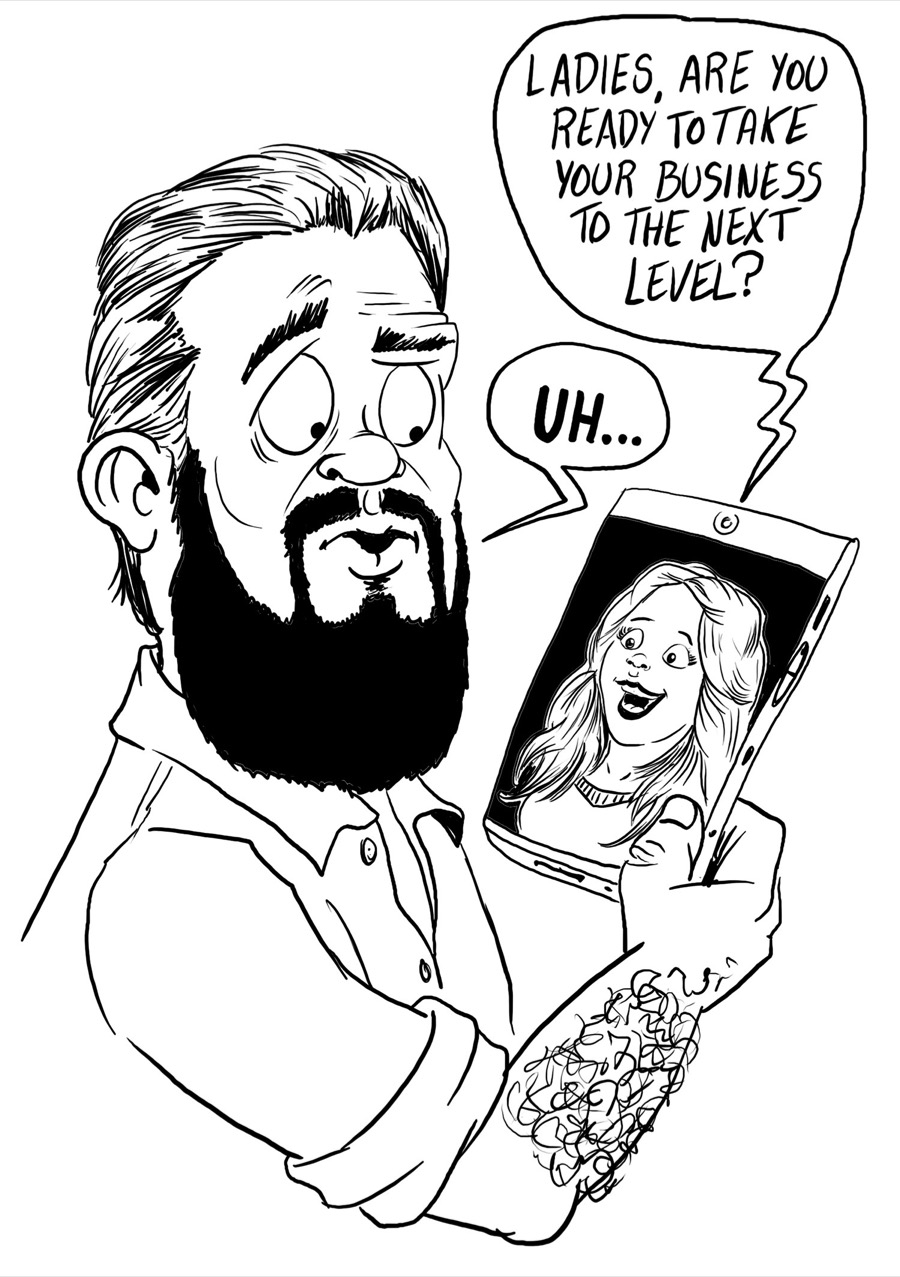
Marie Forleo is among the most impactful teachers of small business tactics in the world, with her weekly videos periodically topping a million views and her premier program, B-School, drawing over 10,000 new students a year.
The first time I checked out B-School, the program looked great, but I couldn’t bring myself to pull the trigger. Why not? First was the $2000 price tag, steep for an online course. Second, I feared the material would be too introductory. But the third reason was the true deal breaker. I didn’t know if I was eligible, and I was too embarrassed to ask.
B-School teaches a concept known as the Ideal Customer Avatar (ICA). Rather than targeting your marketing to everyone, Marie encourages you to choose a single individual who represents your ideal customer and target your marketing for them. When I first looked at B-School’s marketing, it was easy to reverse engineer Marie’s ICA. Everything from color schemes and font selections to the interviews she published with B-School alumni showed she was targeting her course to women in their thirties looking to transition from employees to entrepreneurs. While nothing stated the course was only for women, the complete lack of men made me wonder if I was even welcome.
I didn’t join until the following year, when I heard an interview between Marie and Jairek Robbins, where he pointed out that before taking the course his first time, he’d wondered if men were allowed in (Marie has since added a few men to her marketing materials to remove this doubt). Much as I enjoyed B-School, I got more value from observing how Marie constructed and ran the course to deliver maximum value.
One technique that left a deep impression was Marie’s reliance on secret bonuses, components she hadn’t breathed a word about during promotion that were thrown in as extras during the course. My favorite bonus was a behind-the-scenes look at the mechanisms that powered B-School, which taught me about course construction and how to manage a large community.
At first, the idea of including secret bonuses struck me as counterintuitive. Remember, Marie was billing $2000 for an online course. To get participants to pay that much, wouldn’t she want to boast about every bit of value? Why offer benefits you intentionally leave out of your advertising?
The answer is that Marie wasn’t just thinking of the initial sale alone. The last thing she wanted was for people to sign up, believe they didn’t get their money’s worth, and say that her course was a ripoff. Rather, Marie wanted past students to become her biggest advocates. And one way to turn customers into advocates is to Over Deliver.
Over Delivering is the second of the three factors that minimize the impact of failures. It goes hand in hand with Risk Reversal, as the more you Over Deliver, the less likely customers are to ask for refunds.
One note of caution on Over Delivery, it works best when it comes as a surprise. Had Marie included her bonuses in her promotional materials, they’d no longer be viewed as extras but expectations. When you give surprise bonuses, you delight customers in ways you never could by simply fulfilling promises.
Ideally, you want everyone who works with you to feel like you’ve Over Delivered. As we’ll see in the next example, Over Delivery has little connection to the actual value your customers receive. It’s a relative measure based solely on expectations.
Let’s contrast my B-School experience with an incident that occurred a few hours before I wrote the first draft of this section.
At the time, my newest obsession was AppSumo, a software site that offers absolutely insane deals. For instance, I bought a graphic editor that normally costs $96 a year, but on AppSumo I got lifetime (not yearly) access for only $49. At first, I couldn’t figure out how they could offer deals so inexpensively. Then I realized their secret sauce. Because they have such a strong, active community, any company they feature gets massive exposure. The top apps in each niche would never undermine their own pricing by giving away such deals, but newer brands looking to make a name for themselves can scale up quickly by working with AppSumo.
Reviews are key on AppSumo, and I’ve found them extremely reliable. Smart brands engage with the Sumolings (the community members) to generate strong buzz for their product. Still, I was unprepared for what happened the second time I bought a lifetime license, this time for a social media scheduling app.
Within a few days, I received an email from the CEO offering to personally give me a demonstration of the platform. While I knew companies worked hard to impress the Sumolings, I wasn’t expecting that level of service. I clicked to book a time on the CEO’s personal calendar. Since the company was willing to go to such efforts, I anticipated a valuable call and paid one of my staff to also attend so she could familiarize herself with the platform.
We both logged on early and eager to learn. A woman from the company joined us, quickly stated her name, and launched into her training, which felt so rote, it was either memorized or read off her monitor. I finally managed to interrupt her and ask, “Where’s the CEO?”
“Oh, he’s too busy to do these calls himself.”
So the CEO had no intention of conducting the demonstration, which left me both frustrated and scratching my head. Why make such an offer if you don’t aim to deliver? We all know salespeople often overpromise to make a sale, but in this case, I’d already bought their product, and I owned a lifetime subscription, so they clearly weren’t doing it to get more of my money. I expect they were hoping to cultivate goodwill. And offering a free demonstration could be an excellent avenue for goodwill. But in this case, because they promised the CEO himself, it set an awfully high bar. When they failed to live up to that bar, it created a negative impression, not a positive one. In the end, I left them a review entitled, “Overpromised, Under Delivered.”
This was the exact opposite of B-School, which under-promised and Over Delivered. That much should be obvious. But I want to focus your attention on an aspect of the dynamic that may not be so clear. Absolute value played no role.
B-School is a $2000 program. That’s a serious amount of money to pay for an online course. Yet, because Marie threw in a few unexpected bonus trainings, I walked away feeling I got more than I bargained for, and I’ve circulated positive reviews ever since.
With the social media app, I got an absolute steal on the software. The value for my money was through the roof. Then the company offered a free one-on-one training, which they didn’t have to do and which I wasn’t expecting; it should have left an extremely positive impression. But because they made a claim they didn’t stand by, I was left with a bad taste in my mouth and docked the company one taco as a result (yes, Sumolings give reviews in tacos, not stars).
By any objective standard, I got a greater bang for my buck with the app than with B-School. But human emotions aren’t logical and calculating. I felt honored to receive the B-School bonuses but manipulated and fooled by the software company.
When it comes to Hurrying up and Failing, your audience will be incredibly forgiving as long as you deliver what you promise, and they’ll be thrilled if you deliver more. When we created Dream, Design, Manifest, we promised participants six two-hour sessions. But since we weren’t experts in teaching the material online and didn’t know where our students would struggle, we kept looking for opportunities to add more value. Each week we offered bonus sessions, many of them created on the spot to address weaknesses we identified in our own curriculum or additional needs of our audience. For instance, a number of our students were looking to start their own businesses, so I threw in a bonus class on my favorite business principles.
Next time we run the course, I expect our core curriculum will be stronger, and as a result, we might choose to add fewer bonus sessions. But we’ll always try to offer value we haven’t advertised as part of the course.
Before leaving this section, take a moment to think about your own offerings. Are there elements you can add to your offering that will surprise and delight your clients? Here are a few tips to help you exceed expectations:
- Brainstorm a range of low-cost, high-value bonus offerings. What are additional things you can give your clients, above and beyond your core product or service that they will love? To avoid killing your profit margins, try to create bonuses that give your clients strong value, but cost you little to deliver. For instance, if you’re selling a paperback book, your clients might be delighted to get a second paperback for free, but your cost to print and deliver a second book can add up. A video course that goes deeper into the lessons of the book might be more effective because once it’s created you can give access to thousands of clients for minimal additional cost.
- Divide your bonuses into those you include in your initial offer and those you’ll reveal later. Potential clients need to be sold on the value they’ll get from your product or service. One of the most effective ways of raising the perceived value is by offering bonuses as part of the sign up. Select a few of the bonuses you’ve created and include them with your offer. Just know that the bonuses you added into your initial offer will not make clients feel you’re going above and beyond for them. Once they’re part of the offer, they’ve now become expectations. That’s why you want to hold some bonuses back for later.
- Keep your secret bonuses secret. It’s so hard to hold back from telling potential customers all they’re going to get. Especially when you have someone sitting on the fence, you just want to spill the beans and tell them there’s so much more than they know. Restrain yourself. Even hinting that you’ll be giving secret bonuses later on can kill the impact these bonuses will eventually have.
- Gather feedback along the way. You may think you’ve put together a fabulous offering, but once your clients start engaging with it, they might find it lacking in ways you didn’t expect. That knowledge can be gold. If your client feedback shows you holes in your offering, rush in to fill them. Creating additional bonuses to fix the problems in your initial offer may leave clients more impressed than if you’d created a flawless product to begin with.
- Use Limited-Time Risk Reversal. Allow your customers a window of time where they can get their money back if unsatisfied. So if you have a six-week course, you may offer a money-back guarantee during the first two weeks. Make sure to launch some of your secret bonuses during this period to really blow everyone away. But just offering the guarantee can increase satisfaction with your product.
- Follow-up. Everyone wants to be heard. Even a client with a lukewarm experience will feel better if they have a chance to make their voice heard. Be open to honest feedback, and make sure you actually take time to read it and respond appropriately.
The first two elements we’ve looked at in this chapter can make people more forgiving of your failures. Risk reversal can ensure your clients won’t suffer financial loss if dissatisfied. And if you can make your products go beyond expectations in one area, your clients will be more likely to overlook other areas where you may have fallen short. But wouldn’t it be great if you could find a way for your clients to not only put up with your failures, but actively enjoy going through the learning process with you? This final section will show you a way to accomplish exactly that. Just be forewarned, you may not like it.
